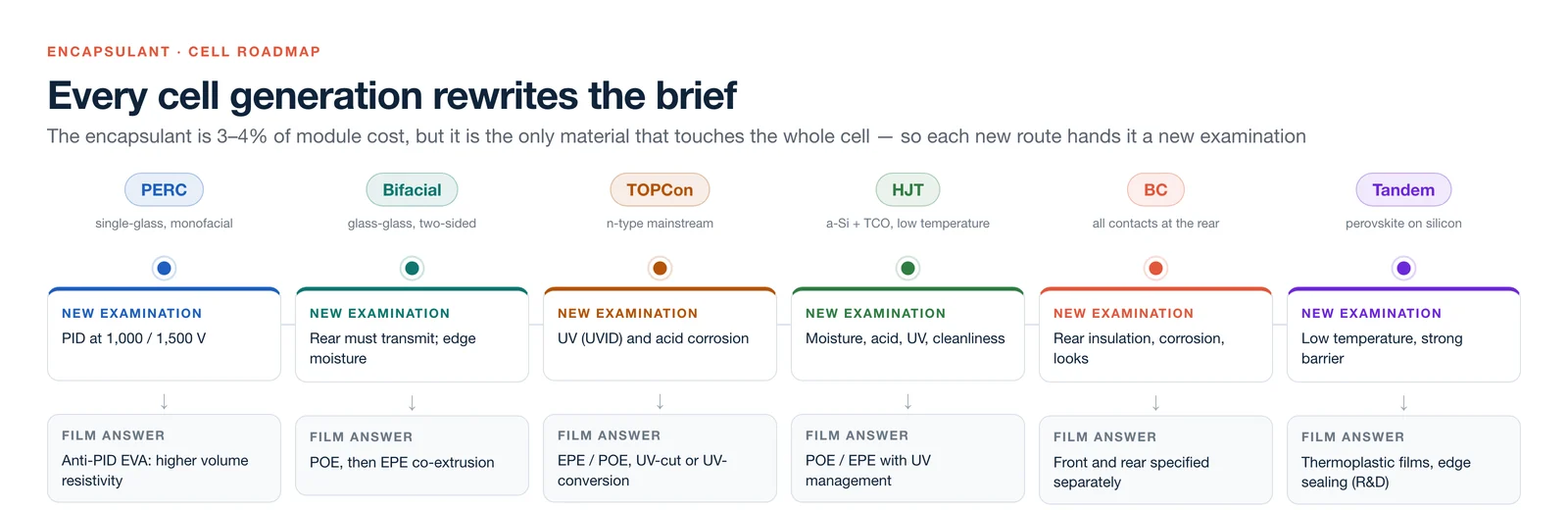
The encapsulant is the cheapest structural material in a solar module — roughly 3–4% of the bill of materials — and it is the one that is wrapped around every square millimetre of the cell for twenty-five years. That combination makes it a follower: when the cell changes, the film is the first component asked to solve the new problem.
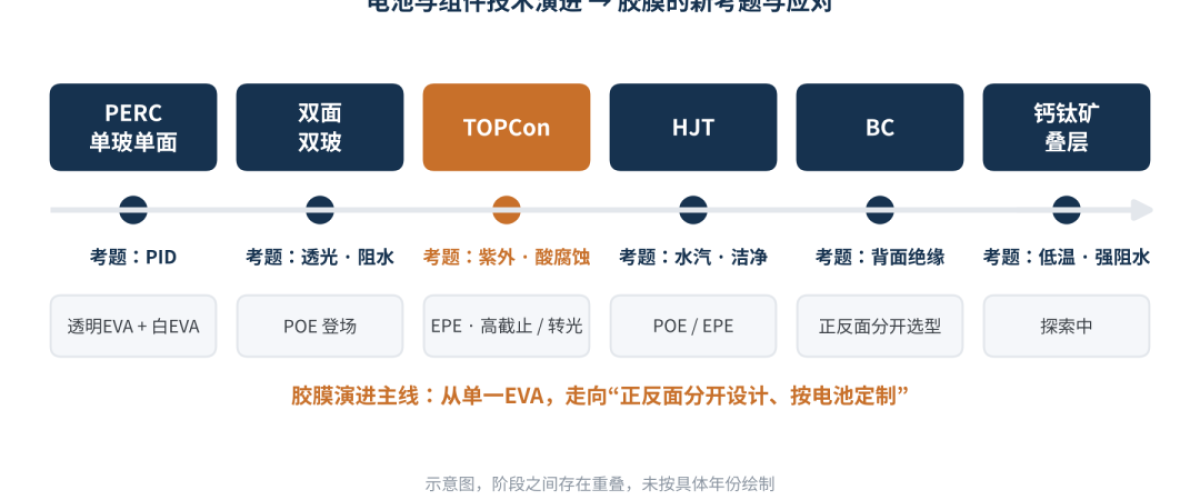
This article follows the cell roadmap and looks at what each generation has demanded of the film. It is less a materials catalogue than a record of examinations: PID for PERC, moisture for glass-glass, ultraviolet for TOPCon, cleanliness for HJT, rear insulation for BC.
A market that now runs on three routes
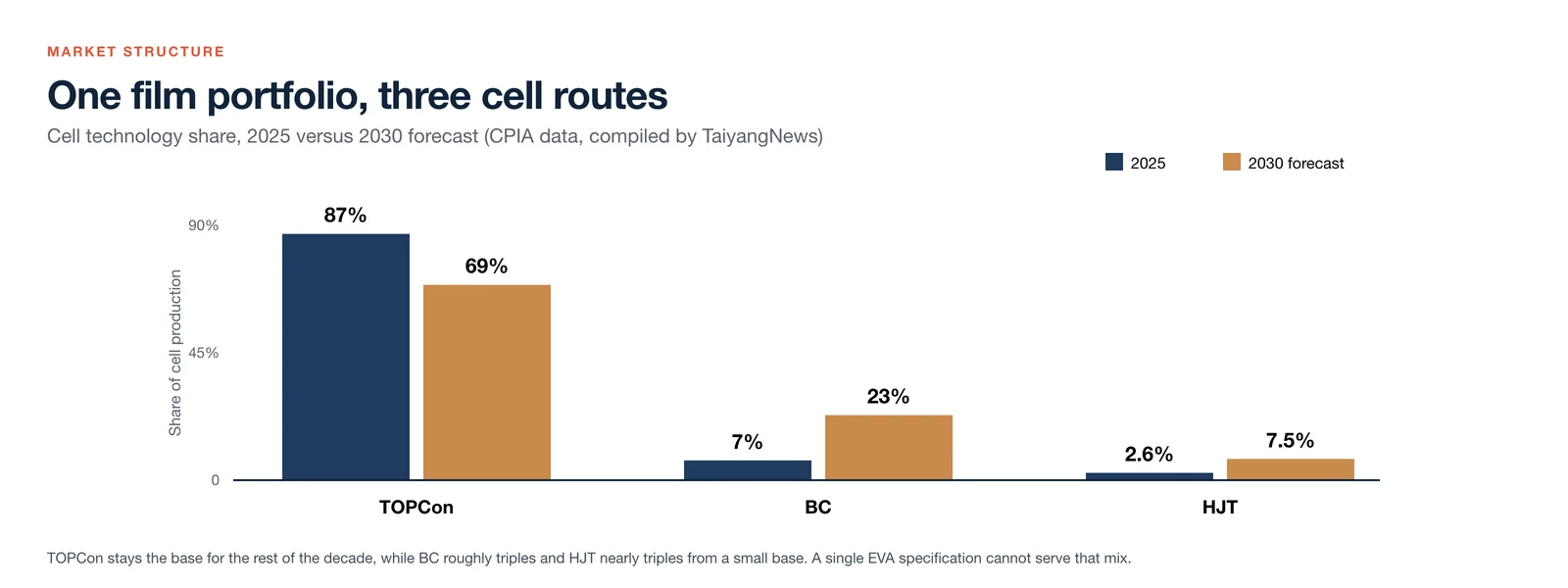
N-type has taken over. CPIA figures compiled by TaiyangNews put TOPCon at about 87% of cell production in 2025, with BC at roughly 7% and HJT at 2.6%. By 2030 the same source expects TOPCon to ease to about 69% while BC rises to 23% and HJT to 7.5%.
The implication for a film maker — and for anyone specifying modules — is that a single encapsulation recipe no longer travels across a product range. The same lamination line now has to run a stable TOPCon bill of materials while being ready for BC and HJT growth.
PERC and single glass: the PID years
In the p-type PERC era, the answer was almost standard: transparent EVA on the front, white or transparent EVA on the rear, a backsheet behind it. The examination of that generation was potential-induced degradation. As system voltages moved to 1,000 V and then 1,500 V, modules in hot and humid conditions lost power through ion migration from the glass and the frame into the cell.
The film industry answered with anti-PID EVA: formulations with higher volume resistivity and lower ion mobility, so that the leakage path through the encapsulant is restricted. That is where the "insulation" job described in the first article of this series became a specification rather than a footnote.
Bifacial and glass-glass: the rear has to transmit light
Bifacial cells turned the rear film from a reflector into a window. White EVA was out, because the back of the module now had to generate. At the same time, bifacial products moved to double-glass construction, which introduced two new problems.
Moisture. In a glass-glass laminate the perimeter is the only route in, and once water is inside it has nowhere to go. The module sits in a warm, humid enclosure for years, so the film needs a genuinely low water-vapour transmission rate and resistance to hydrolysis.
PID. Two sheets of glass and a high system voltage raise the risk further. POE arrived on the strength of a high barrier, high resistivity and no acid generation, first in bifacial PERC glass-glass products; EPE co-extruded film then took much of that volume by putting a POE core between EVA skins to balance cost.
TOPCon: ultraviolet moves to the front
TOPCon is the volume base of the n-type transition, and it handed the film a new examination: ultraviolet. The front passivation stack of a TOPCon cell is more sensitive to UV, and long exposure can drive UV-induced degradation — UVID.
Kiwa PVEL's reliability testing has flagged HJT and TOPCon modules as comparatively UV-sensitive, particularly when paired with UV-transparent films. Its test applies 120 kWh/m² of front-side UV at 60 °C, roughly one to two years of outdoor UV dose. In more recent rounds, some commercial PERC modules have also shown UV-related power loss.
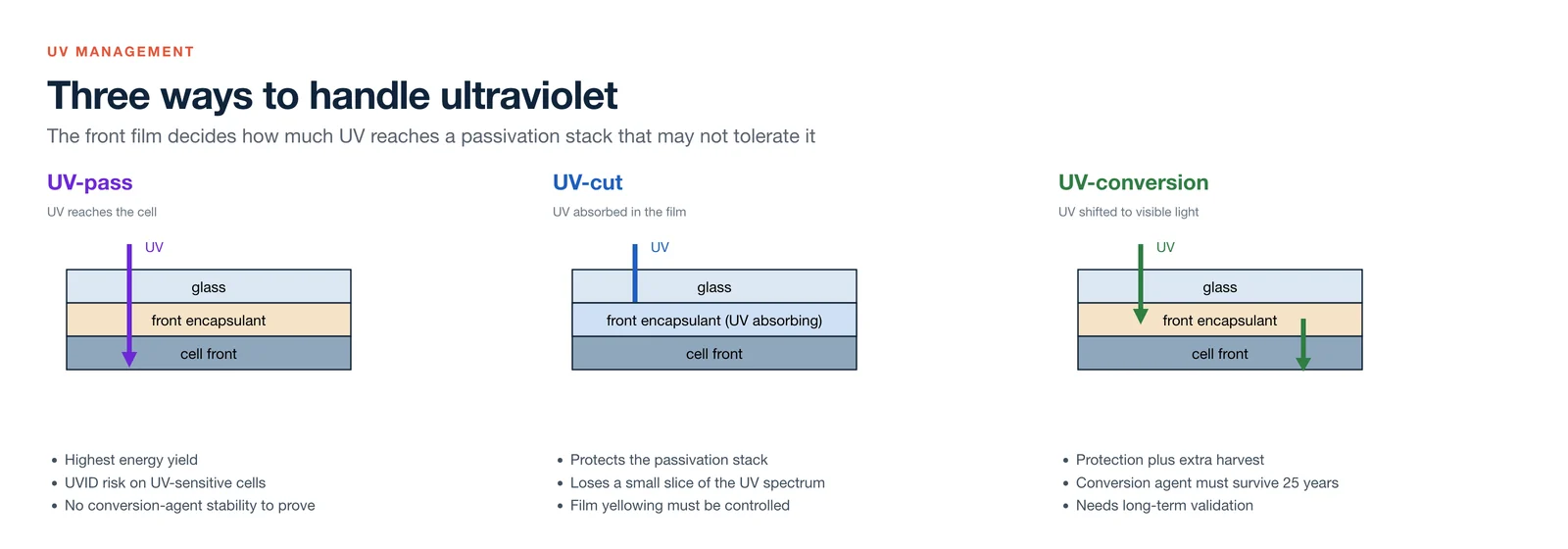
Film makers have three routes. UV-pass films transmit the whole spectrum and harvest the most, at the cost of UVID exposure. UV-cut films absorb the UV band, protecting the cell but giving up a small slice of generation and adding a yellowing risk of their own. UV-conversion films shift UV into visible light, which protects the cell and adds a little harvest — provided the conversion agent survives twenty-five years outdoors, which still has to be proven.
TOPCon also brought back an old problem in a new form: acid. The metallisation is sensitive to acetic acid released by EVA hydrolysis, which is one reason TOPCon glass-glass modules have largely standardised on EPE or POE rather than EVA.
HJT: the most sensitive cell, and a warning about cleanliness
Heterojunction cells use amorphous-silicon passivation, a transparent conductive oxide and low-temperature silver paste. The whole flow is low-temperature, and the structure is sensitive to moisture, acid and UV, so the film is usually asked for a high barrier, no acid generation and managed UV — POE is the common answer.
But a 2024 study from UNSW is worth putting next to that. Sen and colleagues found that severe damp-heat failures in HJT and TOPCon modules were dominated by contact contamination introduced during cell handling — sodium, calcium, chlorine and sulphur from gloves and vacuum suckers. Contaminated cells lost roughly 10–16% of relative power after 1,000 hours of damp heat even with a high-quality POE film; cleaned cells degraded very little whether the film was EVA or POE.
The lesson is uncomfortable but useful: the film can slow moisture and ions down, it cannot cure a contaminated cell. A high-end cell route raises the requirement on the film and on the cleanliness of the whole line at the same time.
BC: clean front, crowded rear
Back-contact cells move both polarities to the rear, which leaves the front free of gridlines and gives the product its uniform all-black look — one reason BC is popular in distributed and architectural work.
For the film, BC is asymmetric. The front behaves like any high-efficiency cell: transmission and UV management. The rear is crowded — interleaved p and n electrodes with small gaps — so the rear film has to keep fine electrodes insulated over decades, resist corrosion in damp heat, and, for the all-black products, hide the pattern behind a dark, opaque film. That is why BC is increasingly specified with a different film on each side.
Route by route
| Cell / module route | The main examination | Usual film answer |
|---|---|---|
| PERC, single-glass monofacial | PID, cost | Transparent EVA + white EVA |
| Bifacial PERC, glass-glass | Rear transmission, PID, moisture | POE / EPE |
| TOPCon, glass-glass | UV (UVID), acid corrosion, moisture | EPE / POE, UV-cut or UV-conversion |
| HJT | Moisture, acid, UV, cleanliness | POE / EPE with UV management |
| BC | Rear insulation and corrosion, appearance | Front and rear specified separately |
| Perovskite tandem | Low temperature, strong barrier | Thermoplastic films, edge sealing (in development) |
The direction is clear: from a single EVA recipe towards front and rear films designed separately and matched to the cell. Within a few years the two sides of the same module will routinely be different products.
What to ask a supplier
- UVID data for the exact cell type, not a generic film datasheet — and at module level, not cell level.
- PID results to IEC 62804 on the finished laminate, at the system voltage you will actually run.
- Whether the film is UV-pass, UV-cut or UV-conversion, and what that costs in yield versus what it buys in degradation.
- Volume resistivity and water-vapour transmission for glass-glass products, because both drive wet-heat and PID behaviour.
- Handling and cleanliness controls on the cell line — the UNSW result is a reminder that the film is not the only variable in a damp-heat failure.
How ZOEAST PV specifies encapsulation
We build glass-glass and single-glass n-type modules on two fully automatic lines in Yixing, Jiangsu, and we specify EVA, POE or EPE per project rather than defaulting to whichever film is cheapest that month. For coastal, floating and high-humidity sites the default is POE or EPE in double-glass construction; for dry, temperate utility projects EVA keeps the cost per watt down without giving up the 25-year warranty.
Because TOPCon and BC have different front and rear requirements, our bill of materials states the film on each side separately — including the UV policy for TOPCon and the rear insulation and opacity requirements for all-black BC products. Incoming material is checked on water-vapour transmission and volume resistivity per batch, and finished modules go through PID testing to IEC 62804 before they ship.
The same discipline carries across the range, from 460 W structural-colour modules for façades — where the film also has to protect a colour layer — to 285–410 W agri-PV bifacial glass-glass modules that live above crops in constant condensation and UV.
Compare the options on our N-type module range, or send us your site conditions and we will specify the film with the module.
Data notes: cell technology shares (2025: TOPCon ≈87%, BC ≈7%, HJT ≈2.6%; 2030 forecast: ≈69% / 23% / 7.5%) are CPIA figures compiled by TaiyangNews; other houses such as ITRPV and Exawatt publish different estimates. UVID test conditions and conclusions follow Kiwa PVEL public material. The damp-heat and contamination findings follow Sen C., Wang H., Zhu Z., Li A., Khan M.U., Hoex B., "Hidden Fingerprints: How Solar Cell Handling Leads to Damp Heat Failures in HJT and TOPCon Modules", APVI Solar Research Conference, 2024. Figures: ZOEAST PV, redrawn in English from the original technical article.