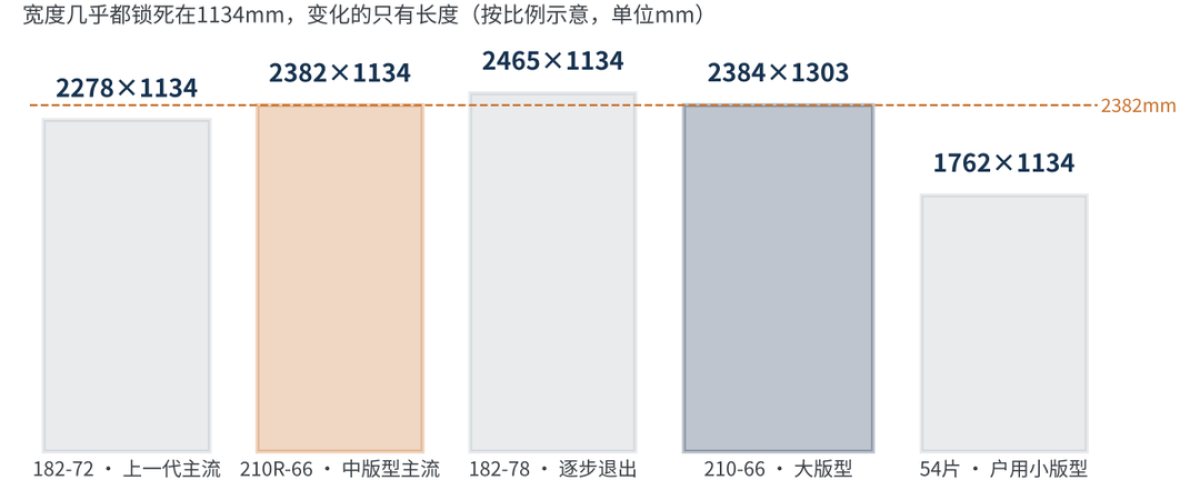
Module formats used to change every year: 156 mm, then 166, then 182, then 210, then a wave of "182+X" rectangles, each supplier a few millimetres off the next. Then, around 2023, the industry quietly settled on a handful of standard faces — 2382 × 1134, 2278 × 1134, 2384 × 1303 — and stopped.
Nobody decreed it. The formats were computed, by three boundaries that have nothing to do with cell technology: a shipping container, a mounting rail, and a round silicon ingot.
The faces that survived
| Format (mm) | Wafer | Cell layout | Typical use |
|---|---|---|---|
| 2382 × 1134 | 210R, 182.2 × 210 | 66 cells (132 half-cells) | Utility and commercial; the current mainstream middle format |
| 2278 × 1134 | 182 square, 182.2 × 182.2 | 72 cells (144 half-cells) | Previous mainstream; large installed base |
| 2384 × 1303 | 210 square, 210 × 210 | 66 cells (132 half-cells) | Large utility-scale plants |
| 1722 / 1762 × 1134 | 182 square or rectangular | 54 cells (108 half-cells) | Residential and distributed |
Look closely and a pattern appears. Apart from the 210 large format, nearly every width is nailed to 1134 mm; only length varies, and length stops near 2382 mm. Why can the width not move, and why does the length stop where it does?
Boundary one: a 40 ft high-cube container
Modules travel by sea, and the unit of sea freight is the 40 ft high-cube container: about 12,032 × 2,352 × 2,698 mm internally, with a door opening of roughly 2,570 mm. The box predates the solar industry, so its dimensions are the ceiling that modules have to obey.
Modules ship side-standing — long edge down, short edge up — because that orientation survives transport vibration with fewer microcracks. A pallet's height is therefore the module width plus the pallet base, and to fill the box you stack two pallets. That produces the first constraint: two pallets plus roughly 100 mm of forklift clearance must clear the 2,570 mm door, which caps module width near 1,130 mm. That is where 1134 mm comes from — and, in the other direction, why 182 mm wafers (six columns) were the natural fit at the time.
The second constraint is simple division. With 12,032 mm of interior length, five pallets of a 2382 mm module fit with 52 mm to spare; a slightly longer module drops you to four pallets and 82% utilisation.
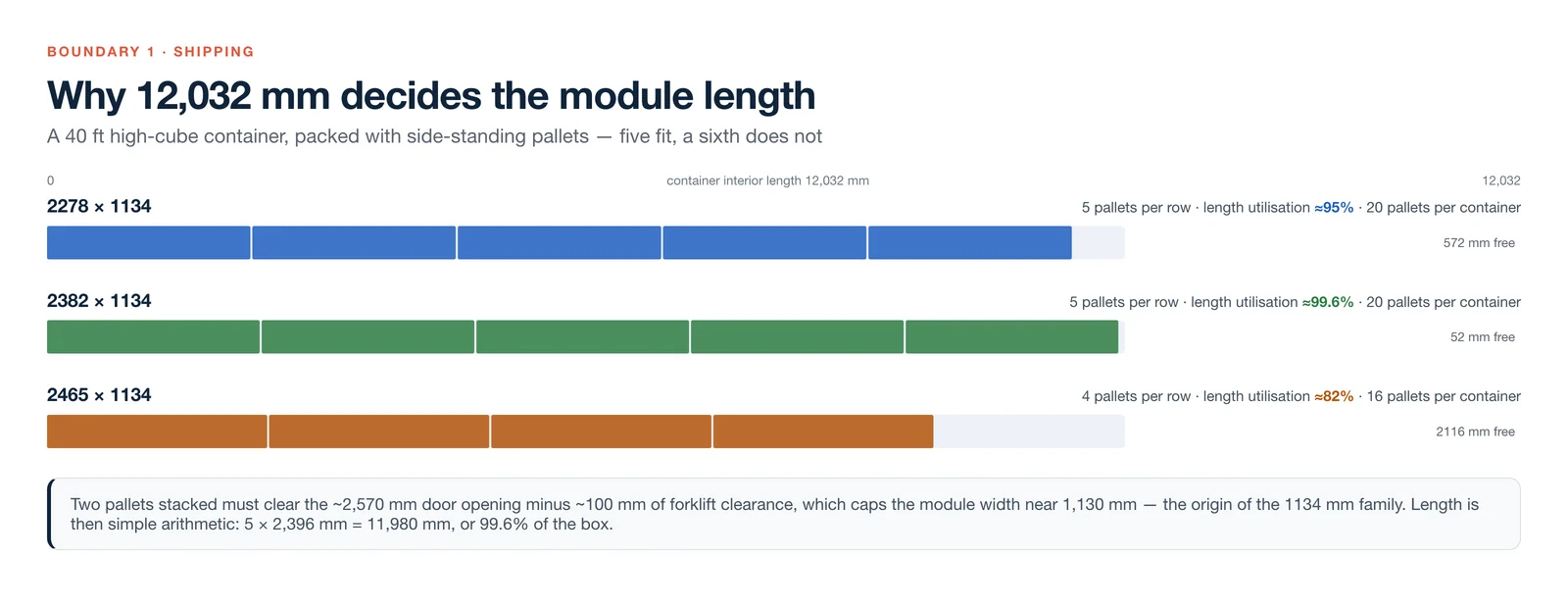
| Format (mm) | Pallet length (est.) | Pallets per row | Length utilisation | Pallets per container |
|---|---|---|---|---|
| 2278 × 1134 | ≈2,292 mm | 5 | ≈95% | 20 |
| 2382 × 1134 | ≈2,396 mm | 5 | ≈99.6% | 20 |
| 2465 × 1134 | ≈2,479 mm | 4 | ≈82% | 16 |
The 210 large format shows the cost of ignoring the boundary. At 1303 mm wide, two pallets exceed the door height, so the modules have to be loaded upright — a handling method many customers dislike, and one reason large-format 210 modules found a narrower audience than their area suggested.
Boundary two: racking, glass and mechanical load
Once a module reaches site it sits on a mounting structure for twenty-five years, and the downstream ecosystem imposes its own limits.
Mounting holes. The July 2023 industry initiative that standardised 2382 × 1134 also standardised the long-edge hole spacing at 400 / 790 / 1400 mm. Rails, clamps, trackers and installation crews now work against one interface. Whether a new format is accepted downstream rarely depends on its wattage; it depends on whether it bolts on.
Mechanical load. A module is a glass plate supported at four edges. The wider it gets, the larger the deflection at the centre under the same snow and wind load, and the higher the risk of cell microcracks. Industry white papers put the practical limit near 1.2 m: beyond that, deflection begins to show up as cracking and power loss, and you have to buy thicker glass and a stiffer frame — adding cost and weight.
The glass and the bill of materials. Rolled solar glass furnaces, line widths and cutting patterns are built around the 1134 mm family. Keeping the width fixed means glass, frame, encapsulant and backsheet cutting specifications do not change.
Downstream has two more votes. On single-axis trackers in 1P configuration, module length sets the row height and the wind sail area, so a longer module pushes up the cost of the torque tube and drive. And a format change alters module voltage and current, which moves the modules-per-string count and inverter configuration in a 1500 V system. What installers fear is not a lower wattage; it is a format that forces every rail and every work method to be re-engineered.
Boundary three: a round ingot
The first two boundaries set the frame. The third decides what goes inside it. A monocrystalline ingot is round; a wafer is square or rectangular; everything outside the wafer becomes edge scrap that has to be re-melted and re-pulled.
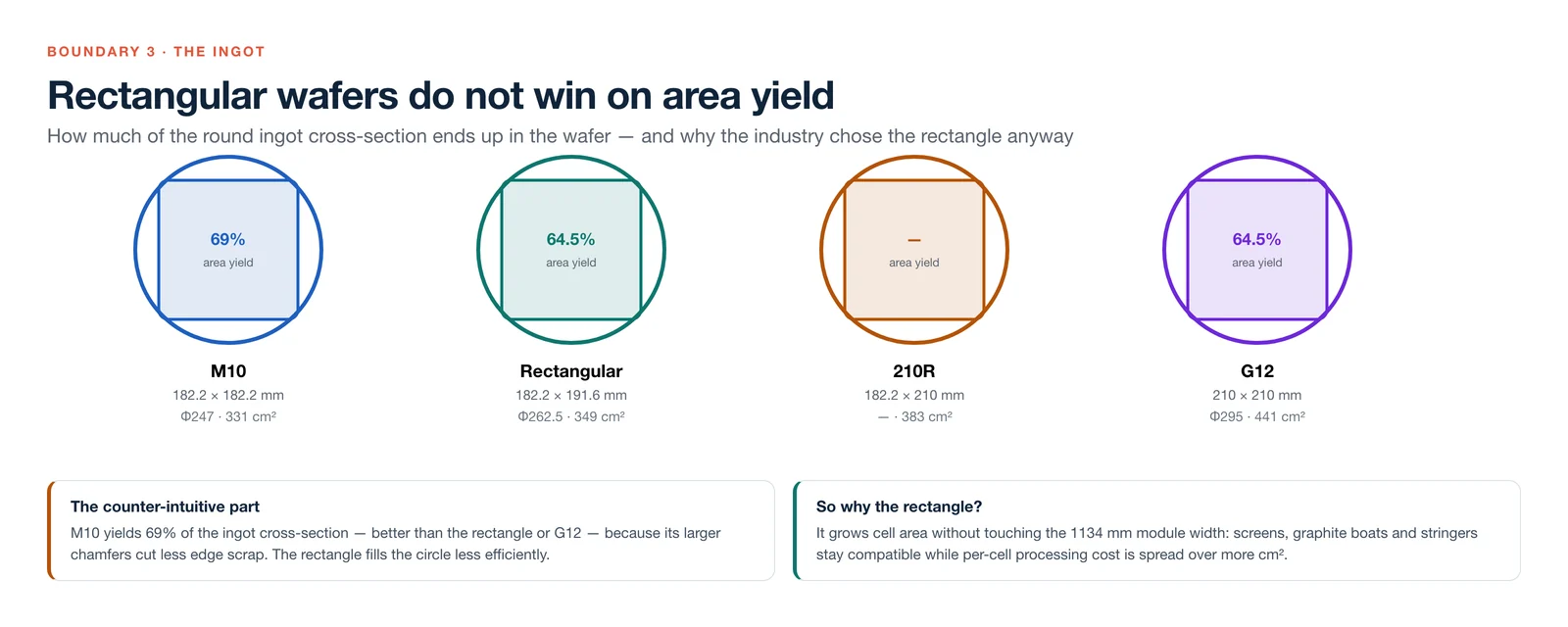
| Wafer (mm) | Ingot diameter | Wafer area (est.) | Cross-section yield (est.) |
|---|---|---|---|
| M10 182.2 × 182.2 | Φ247 | ≈331 cm² | ≈69% |
| Rectangular 182.2 × 191.6 | Φ262.5 | ≈349 cm² | ≈64.5% |
| 210R 182.2 × 210 | Not published uniformly | ≈383 cm² | — |
| G12 210 × 210 | Φ295 | ≈441 cm² | ≈64.5% |
The result surprises most people. M10 yields about 69% of the ingot cross-section — better than the rectangle or G12 — because its larger chamfers cut less edge scrap. Rectangular and 210 wafers are cut almost corner-to-corner, which gives a more complete cell and less dead space in the module, but consumes more of the ingot as scrap.
So why did the industry choose the rectangle? Because it grows cell area without touching the 1134 mm module width. Screens, PECVD graphite boats, stringing equipment and glass cutting are all sized by width; stretching the other edge from 182.2 mm to 191.6 mm, and then to 210 mm, lifts single-wafer area from roughly 331 cm² to 349 cm² and on to 383 cm², spreading every per-wafer process step over more silicon.
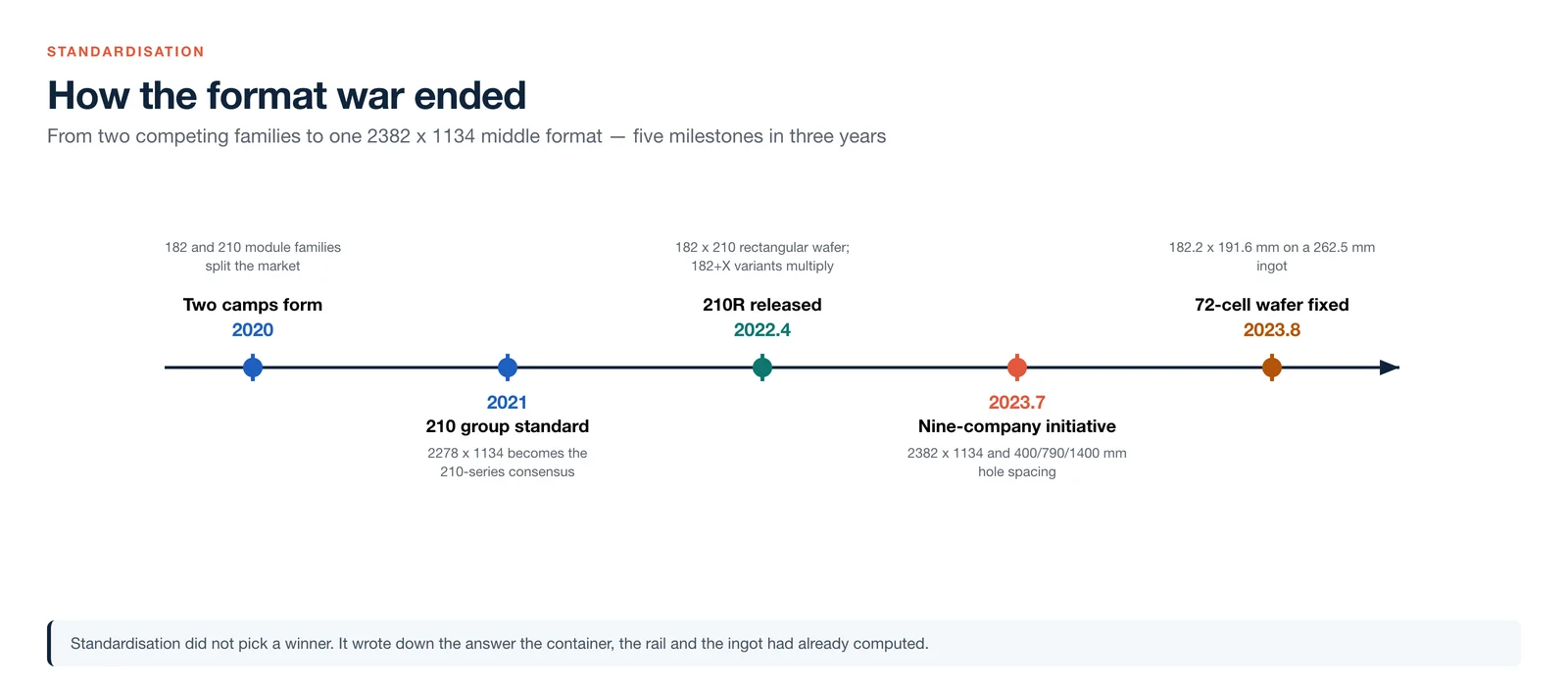
The remaining question was how far to stretch. Around 2022 suppliers produced 182 × 183, 182 × 185, 182 × 188 and planned 182 × 192 — a few millimetres apart. Each variant needs its own ingot diameter and hot zone at the pulling furnace, and its own cutting specification and inventory at the glass, frame, film and backsheet suppliers. A few millimetres is a whole extra material set. In August 2023 six companies therefore fixed the 72-cell rectangular wafer at 182.2 × 191.6 mm with a Φ262.5 mm ingot, while the 2382 × 1134 middle format standardised on the 210R wafer at 182.2 × 210 mm.
Coordination, not command
On 7 July 2023, nine module manufacturers — Jinko, LONGi, JA Solar, Trina, Canadian Solar, Tongwei, Astronergy, Risen and DAS Solar — signed an initiative on standardising rectangular-wafer module dimensions. It was an initiative, not a mandatory standard. It worked because the three boundaries had already squeezed the option space to almost nothing.
- The boundaries are exogenous. Containers, door openings, glass furnaces and racking systems all predate the format war; no module maker can change them.
- The optimum is nearly unique. Under a 1134 mm width, five pallets per row and compatible hole spacing, the viable length window is only a few millimetres wide — independent calculations converge on the same answer.
- Deviation is paid for by the deviator. Non-standard formats carry more expensive materials, custom racking and a real risk of being excluded from tenders; some owners now write 182 × 210 rectangular cell requirements directly into procurement documents.
An economist would call this a coordination game: everyone gains by standing on the same point, and whoever steps away pays for it. The format war did not produce a winner; it produced a focal point set by physics and logistics.
What happens now
With size settled, competition moves from bigger to better. On the same 2382 × 1134 sheet, TOPCon, BC, HJT and eventually tandem compete on efficiency, bifaciality, reliability and levelised cost. Size became the constant; technology became the variable — which is a healthier basis for the industry than a millimetre race.
The balance is not permanent. A change in shipping rules, tracker architecture or module packaging could reopen the calculation. But as long as the container is still 12,032 mm long, 1134 mm of width and roughly 2382 mm of length are likely to stay.
What buyers should check
- Hole spacing — 400 / 790 / 1400 mm on the long edge — before assuming a new format drops onto existing rails.
- Pallets per container for the actual module, not the brochure format; a few millimetres can cost a whole pallet position.
- Glass and frame availability for non-standard lengths, because those two items carry the longest tooling lead time.
- String and inverter compatibility: a format change moves voltage and current, and therefore modules per string.
How ZOEAST PV works inside these boundaries
ZOEAST PV builds on the standard 1134 mm width family rather than inventing a format. Our residential all-black modules use the 1762 × 1134 mm body (450–475 W, 96 half-cut cells), our utility and agri-PV products the 2382 × 1134 mm and 1960 × 1134 mm bodies, with the standard 400 / 790 / 1400 mm long-edge hole spacing so existing rails, clamps and tracker interfaces fit without re-tooling.
Because the 5 GW cell lines and the 2 GW module lines sit in the same Yixing facility, we can also tell a customer exactly which wafer format sits inside a given module — 182.2 × 210 in the 2382 mm body, for example — and what that means for glass, frame and packing. Where a project genuinely needs a non-standard size, that is a BIPV or colour-module conversation with its own tooling cost, not a default.
See the N-type module range, the agri-PV range, or send us your project parameters and we will confirm the format, packing density and compatible mounting hardware.
Calculation notes: container interior taken as ≈12,032 × 2,352 × 2,698 mm with a door height near 2,570 mm; pallet length estimated as module length plus ≈14 mm of packaging, using the published 2,396 mm figure for the 2382 format; pallets per container assumes two rows of two-high stacks — actual packing follows each maker's scheme. Area comparison: 2382 ÷ 2278 ≈ 1.046, so about 4.6% more module area at the same cell count. Wafer yield is calculated as wafer area ÷ ingot cross-section, ignoring saw kerf, end crops and scrap recovery, for relative comparison only. References: T/CPIA 0003-2022; the 7 July 2023 nine-company standardisation initiative; the August 2023 six-company 72-cell rectangular wafer agreement; JA/Jinko/LONGi 182 module white paper; Trina and industry coverage of the 210R route. Figures: ZOEAST PV, redrawn in English from the original technical article.