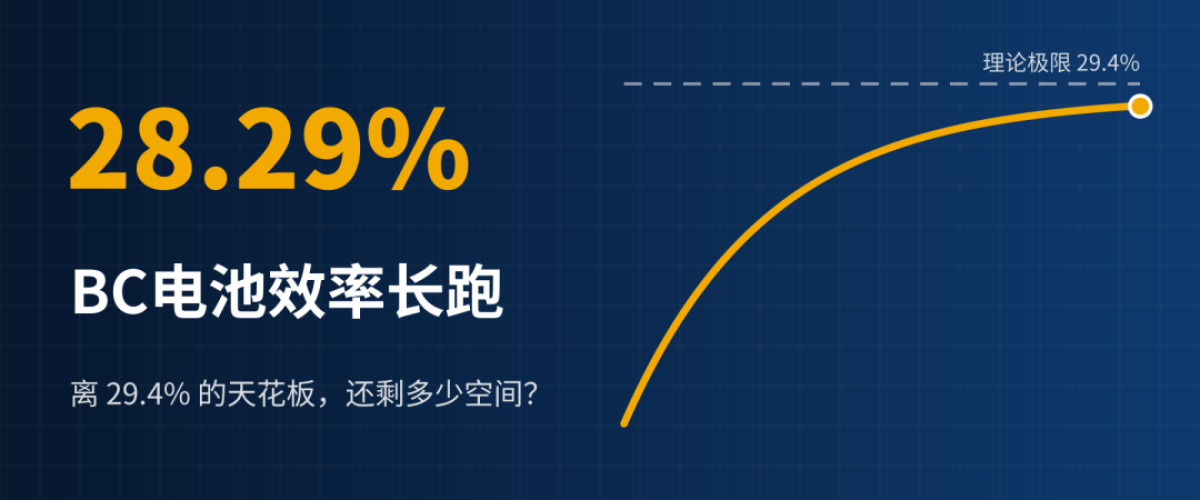
On 24 September 2026 LONGi announced that its HIBC cell had been certified at 28.29% by Germany's ISFH — the third world record for crystalline silicon in a single year, and the first time a silicon cell has reached 96.2% of its theoretical limit.
Record announcements have become routine: 27.81%, 28.04%, 28.13%, 28.29%. But plot those numbers against the 29.4% ceiling and something more interesting appears — the curve is flattening. This article asks three questions: how did back-contact efficiency get here, where is the ceiling, and how much is left for laboratories and production lines respectively.
Sep 2026 · ISFH certified
set by Auger recombination
96.2% of the physical ceiling
First, what back contact actually is
A conventional cell carries rows of metal fingers on the front. They collect current, and they also block light. Back contact takes the obvious step: both polarities move to the rear and interleave there, so the front carries no metal at all — the original name, IBC, stands for interdigitated back contact.
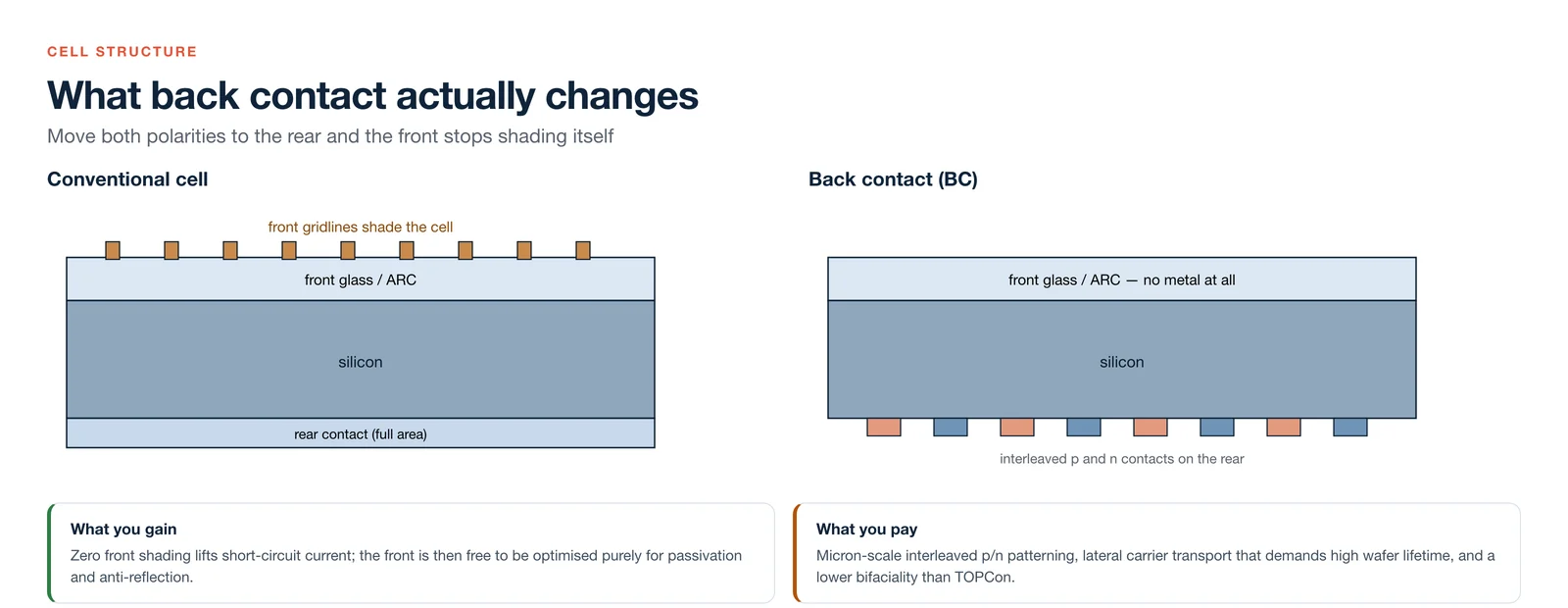
The gain is optical: with no shading, short-circuit current improves immediately, and the front can be optimised purely for passivation and anti-reflection. The cost is manufacturing: the rear needs alternating p and n regions at micron scale, carriers must travel laterally to be collected — which puts a premium on wafer lifetime — and bifaciality is inherently lower than TOPCon's. The principle is forty years old; volume production is three or four years old.
One distinction is easy to miss: BC is a structure, not a passivation technology. It stacks on whatever passivating contact you choose, which is why the industry now has a family of names.
| Route | Passivating contact | Examples |
|---|---|---|
| HPBC | Hybrid passivated contact — the volume workhorse | LONGi HPBC 2.0 |
| ABC | All-back-contact passivation, silver-free focus | Aiko |
| TBC | TOPCon tunnel oxide / polysilicon + back contact | Several TOPCon makers |
| HBC | Heterojunction amorphous silicon + back contact | Kaneka; LONGi's early records |
| HIBC | Low-temperature heterojunction + high-temperature tunnel-oxide polysilicon, both on the rear | LONGi's current record platform |
The record curve: ten years of jogging, three years of sprinting
Order the certified BC records by date and the shape is striking. For six years, Japanese work led: Panasonic reached 25.6% with HBC in 2014, Kaneka took over and reached 26.7% around 2017 — and there the list sat.
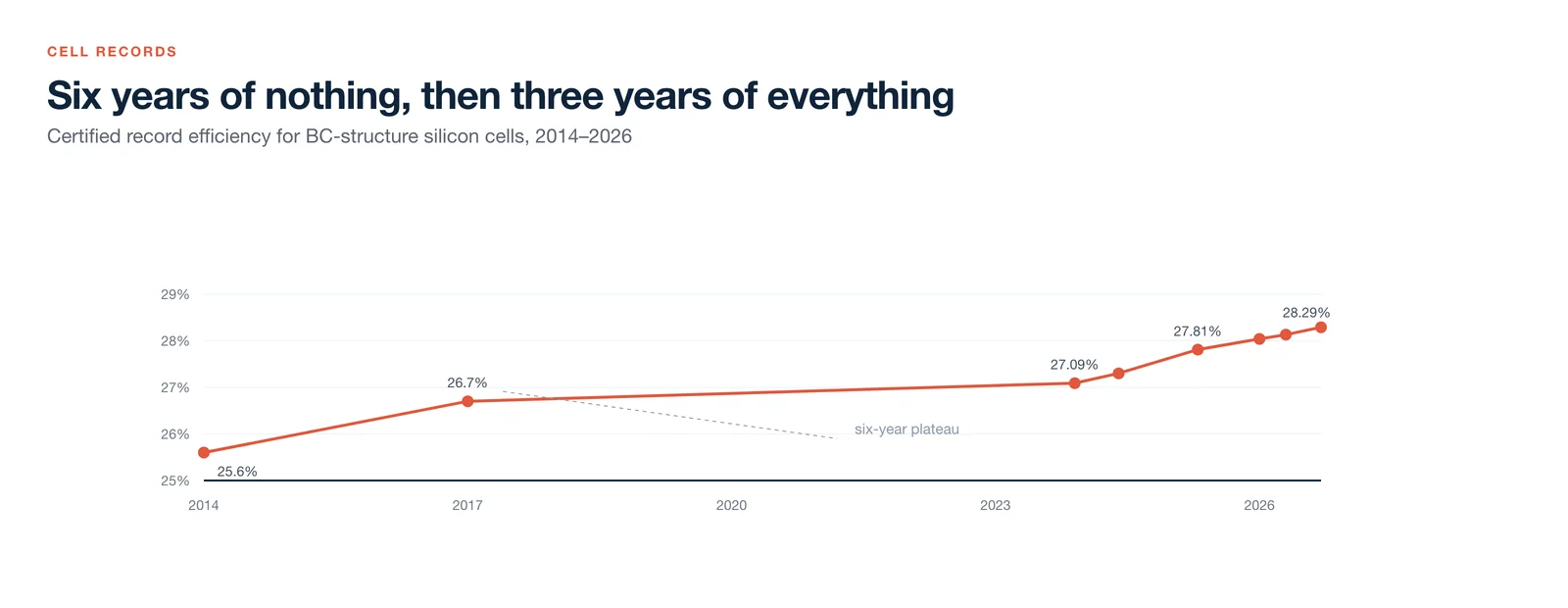
The turn came at the end of 2022, when LONGi built a bifacial heterojunction cell at 26.81% — not a BC device. That result mattered because it proved passivation had matured to the point where further gains had to come from structure, and the largest remaining structural loss was front shading.
What followed was three years of steady records: 27.09% in December 2023, the first above 27%, using full laser patterning instead of expensive lithography; 27.30% in May 2024, then 27.4%, 27.52% and 27.63%; 27.81% in April 2025, published in Nature with an 87.55% fill factor; 28.04% in January 2026, the first above 28%; 28.13% in April 2026, with a certified 26.4% module; and 28.29% in September 2026.
It is not a one-company race. Trina, JA Solar and Jinshi have all reported BC-type research cells in the 28% range. When several leaders land in the same band, it is a technology platform maturing, not a lucky champion device.
The pace, though, is worth separating: 27.09% to 27.81% took sixteen months and gained 0.72 points; 27.81% to 28.29% took seventeen months and gained 0.48. The same time, one third less gain. Each tenth of a point now costs more — not because engineers stopped working, but because physics has started charging rent.
The other curve: production
Record cells set expectations; production efficiency sets the cost of electricity. The production numbers are arguably more impressive.
- Cells. LONGi's first-generation HPBC ran a little above 25%; HPBC 2.0 raised that to 26.6%. Its 2026 interim report says the in-house ACM process is now in GW-scale production with another 0.2–0.3 points available. Leading lines are producing at around 27%.
- Modules. Aiko's ABC module entered the TaiyangNews mass-production efficiency ranking at 23.6% in March 2023 and reached 25% by April 2026; LONGi's HIBC-based EcoLife series also reaches 25%. Aiko has disclosed a fourth-generation product at up to 26%.
- Volume. LONGi's BC module shipments went from about 6 GW in 2023 to 17 GW in 2024 and 23 GW in 2025; the first half of 2026 alone was 19.55 GW, more than 65% of its module shipments.
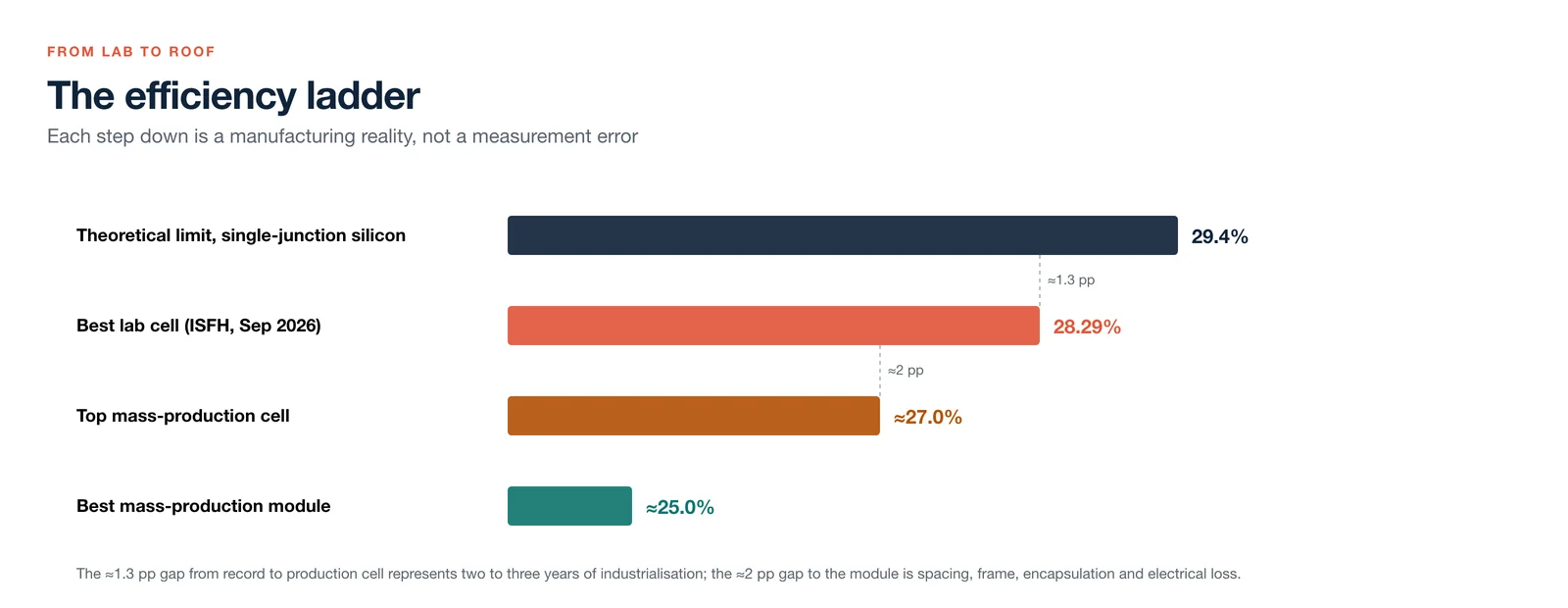
The first gap is a time lag of two to three years: what a laboratory showed at the end of 2023 is roughly what a good line produces today. The second is module-level loss — cell spacing, frame, encapsulation optics and electrical resistance — which module technology claws back piece by piece through full-cell layouts, busbar-less interconnection and high-transmission encapsulation.
Where the ceiling comes from
Two numbers frame the discussion. In 1961 Shockley and Queisser derived the single-junction limit at about 33.7%: photons below the bandgap are not absorbed, and the excess energy of photons above it becomes heat.
Silicon sits at about 29.4%. Its bandgap (1.12 eV) is not at the ideal position, and more importantly silicon is an indirect-bandgap material, so at high carrier concentration Auger recombination becomes unavoidable. Richter et al. (2013) put the limit at 29.43%; later work lands between 29.4% and 29.56%.
So 29.4% is not a process that has not been mastered yet; it is what this material permits. The 28.29% record leaves about 1.1 points — and part of that is not accessible either. The theoretical limit assumes no surface recombination, no resistance and perfect light trapping. A real cell still loses to recombination at the rear junction and edges, contact and lateral resistance, parasitic absorption in the layers and finite bulk lifetime. The engineering limit commonly quoted for BC structures is around 29%, which leaves roughly 0.7–0.8 points to fight for.
The next four years
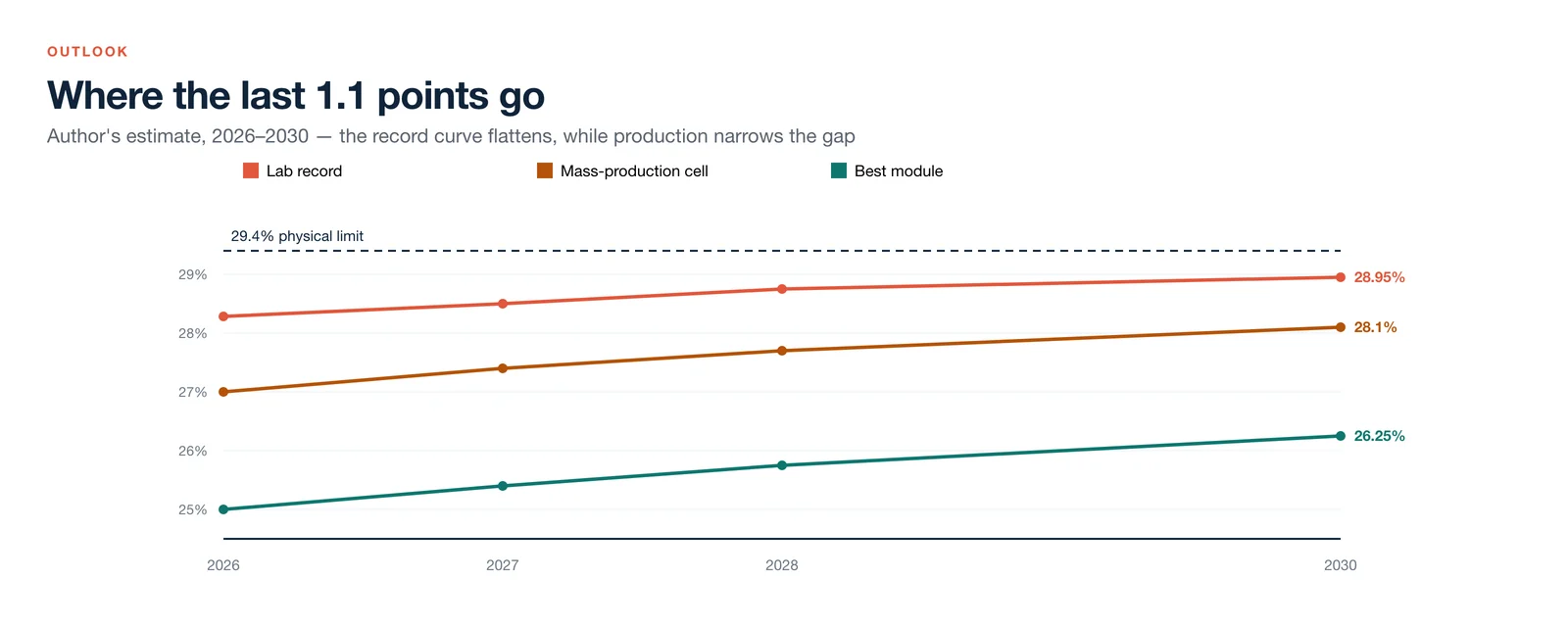
| Metric | 2026 today | 2027E | 2028E | 2030E |
|---|---|---|---|---|
| Lab cell record | 28.29% | 28.4–28.6% | 28.6–28.9% | 28.8–29.1% |
| Top mass-production cell | ≈27.0% | 27.3–27.5% | 27.5–27.9% | 27.9–28.3% |
| Best mass-production module | ≈25.0% | 25.3–25.5% | 25.6–25.9% | 26.0–26.5% |
Three judgements sit behind those ranges. First, laboratory records will keep coming but slower: the 0.4–0.5 points per year of the last three years is not sustainable, more likely 0.2 points a year for the next two, then about 0.1, approaching the engineering limit around 2030. Second, production will move faster than the laboratory, because it is implementing what was validated three years ago — edge passivation, better wafers, copper metallisation and finer laser patterning. Third, competition will shift from the efficiency number to the cost of that efficiency: yield, non-silicon cost, bifaciality and reliability.
Market share is where the forecasts really diverge. CPIA's view puts BC above 30% of the market by 2030; the white paper published by LONGi and Aiko argues for 62%. The disagreement is not about efficiency — it is about how fast cost falls and how willing owners of existing TOPCon capacity are to convert.
After the ceiling: tandem
Silicon approaching its limit does not end the story; it moves the next layer up. A perovskite top cell on a silicon bottom cell splits the spectrum and pushes the theoretical limit to about 43%. LONGi reported a certified 35.5% tandem cell in July 2026, 34.3% on a near-commercial 261 cm² device, and a certified 31.4% tandem module.
Tandem still has to clear stability, large-area uniformity and twenty-five-year lifetime validation. Until it does, BC has a full product cycle ahead of it — and whatever happens above, a good silicon bottom cell remains mandatory.
What this means for buyers
- Judge the line, not the record. A 28.29% certificate says nothing about the yield or the cost of the module you are buying; ask for the production distribution, not the champion cell.
- Ask for module-level certification data — 26.4% on a certified module is a different claim from 28.13% on a cell.
- Compare bifaciality honestly. BC's lower bifaciality matters on a tracker field and much less on a pitched roof.
- Watch the standards. China's mandatory module efficiency standard, published in July 2026, turns "high efficiency" from a selling point into a threshold.
How ZOEAST PV reads this
ZOEAST PV treats back contact as a premium route, not a replacement. Our mainstream is n-type TOPCon — cells and 425–650 W modules built on two automatic lines in Yixing — and we supply BC cells for projects where the all-black front and the efficiency ceiling justify the premium, typically premium residential roofs and visible façades.
Because both cell types pass through the same facility, we can quote the honest comparison for a project: BC gives the better-looking front and a slightly higher efficiency, TOPCon gives better bifaciality and a lower cost per watt. For most utility and commercial work the TOPCon number wins on levelised cost; for architecture, the BC answer is often the only one that satisfies the design intent.
See the cell range, the colour module range for architectural work, or send us your project parameters and we will model both routes against your site.
Data notes: record efficiencies and dates follow LONGi announcements as reported by Science and Technology Daily, IT之家 and others; module-level figures follow TaiyangNews mass-production rankings and Aiko disclosures. Theoretical limits follow Richter et al., IEEE J. Photovoltaics, 2013, and later work by Schäfer/Brendel (2018) and Niewelt et al. (2022). The 2027–2030 ranges are the original author's estimates, not an institutional forecast. Content adaptation and figures: ZOEAST PV.