The 3,000-odd translucent bubbles on the Beijing Aquatics Centre — the "Water Cube" — are not glass. They are ETFE, a fluoropolymer film. The same material is now turning up as the front layer of PV modules, replacing heavy glass so that modules become light and flexible enough to bond onto a metal roof, a camper van, or to roll up and carry away.
This article looks at what ETFE is, why it can replace glass, and what it gives up in the process.
What ETFE is
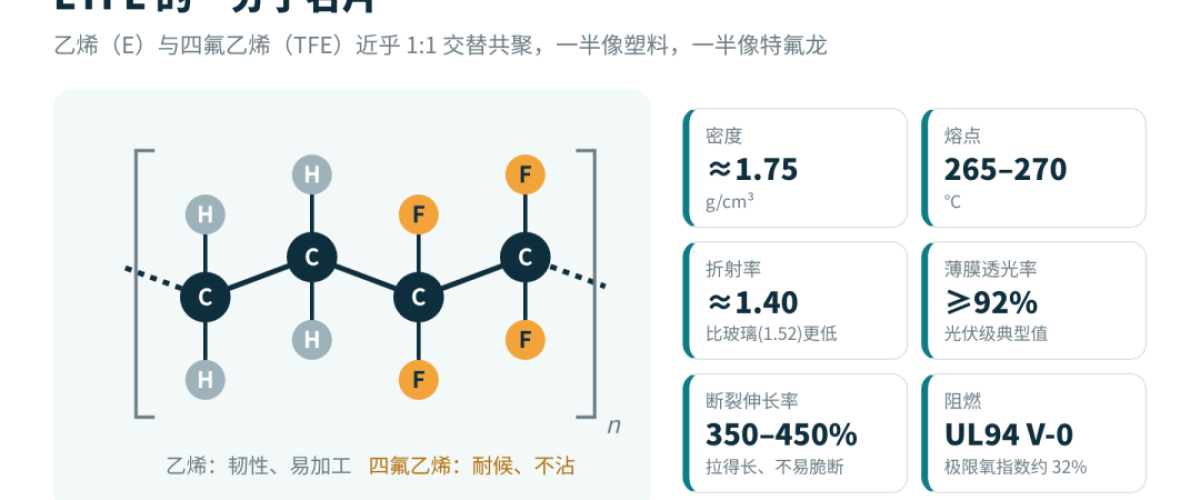
Ethylene tetrafluoroethylene is a near 1:1 alternating copolymer of ethylene and tetrafluoroethylene, commercialised in the 1970s under names such as Tefzel and Fluon. Think of it as half polyethylene, half Teflon: the fluorinated units bring the strong C–F bond and with it UV and chemical resistance plus a non-stick surface, while the ethylene units keep the toughness and melt processability that let it be blown into a film a few tens of microns thick.
Architecture got there first — the Water Cube, the Eden Project in the UK, the Allianz Arena in Munich — with installations outdoors for fifteen to twenty-five years. Long-term outdoor light transmission is exactly what a PV front surface needs.
Where it sits in a flexible module
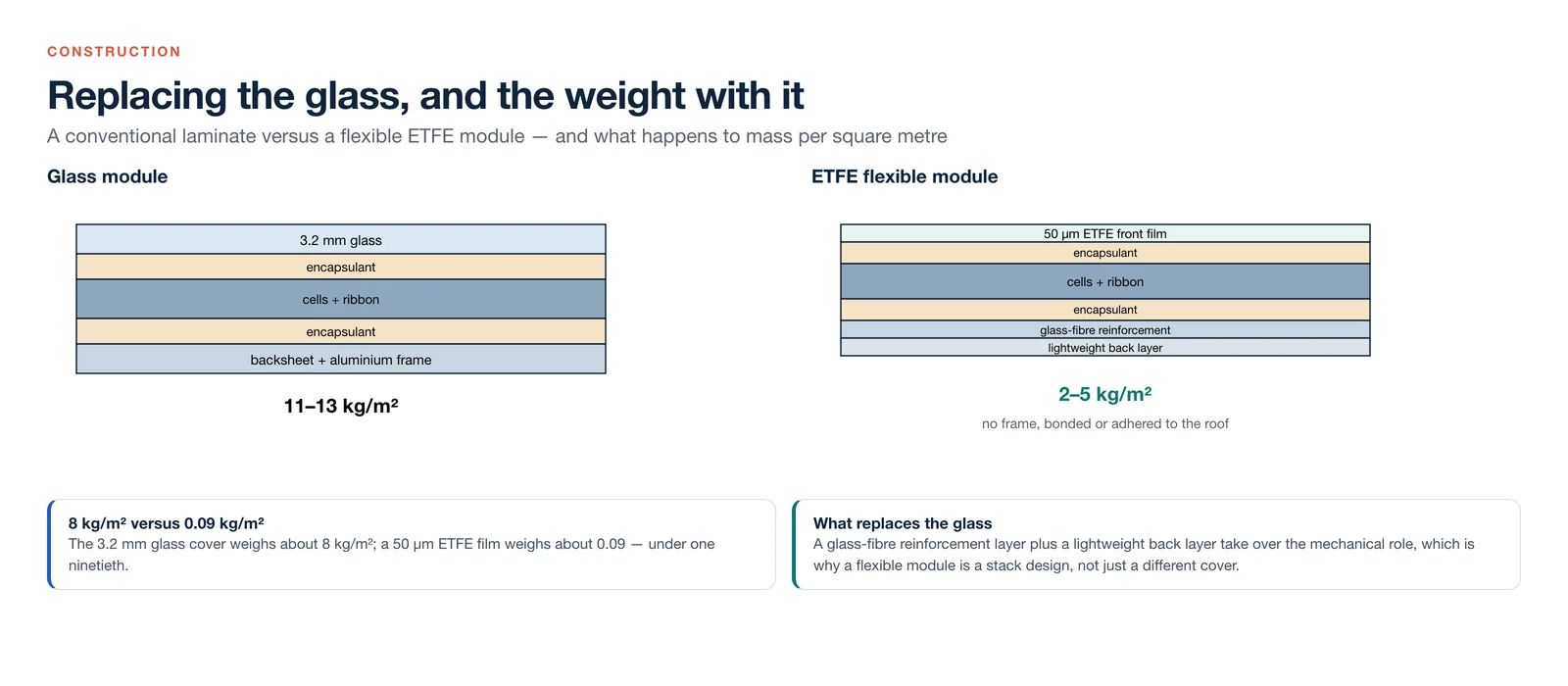
A conventional crystalline module is a sandwich of glass, encapsulant, cells, encapsulant and backsheet, held by an aluminium frame. The 3.2 mm glass is the main weight. A flexible module takes the obvious step: remove the glass and the frame, replace the front with an ETFE film, add a glass-fibre reinforcement layer to recover mechanical strength, and finish with a lightweight back layer.
Why ETFE rather than another clear film
| Property | Typical value | Why it matters |
|---|---|---|
| Front film thickness | ≈50 µm | Weight of the cover layer falls from 8 kg/m² to about 0.09 |
| Transmission | ≥92% | Refractive index about 1.40, closer to air than glass at 1.52 |
| Areal mass, finished module | 2–5 kg/m² | Versus 11–13 kg/m² for a glass module |
| Melting point | 265–270 °C | Continuous service near 150 °C; inherently flame retardant to UL94 V-0 |
| Elongation at break | 350–450% | Survives bending and repeated rolling on curved surfaces |
| Water absorption | <0.03% | High volume resistivity, helpful for module insulation |
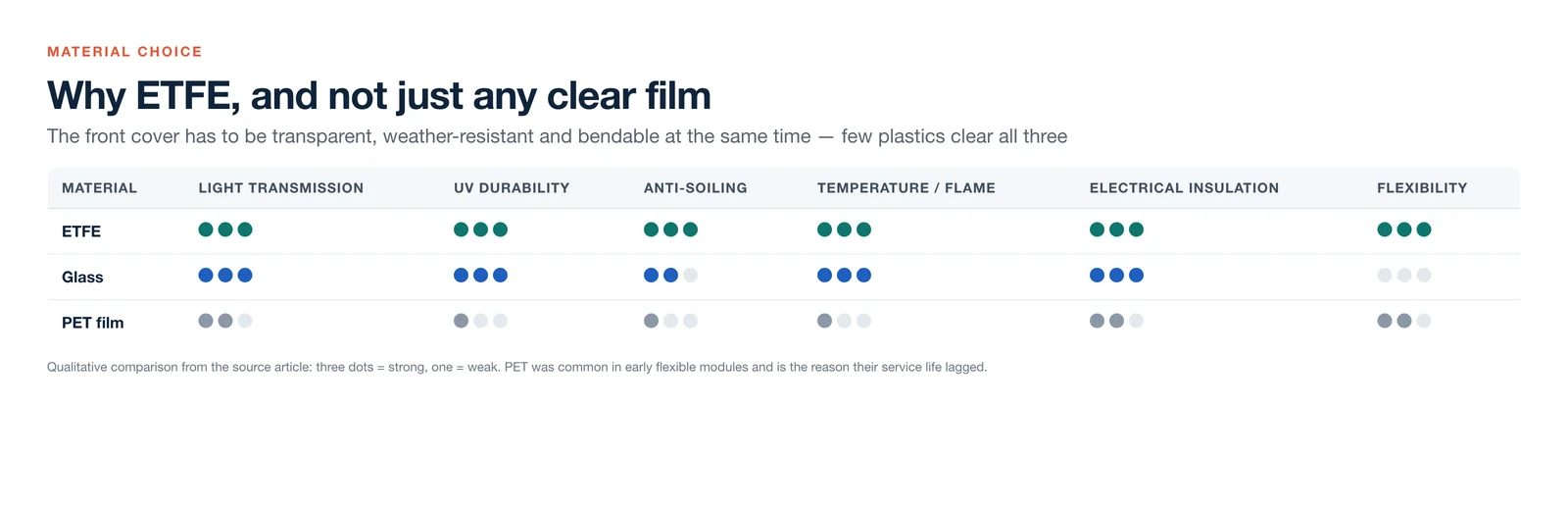
The comparison that matters commercially is with PET, the film used in early flexible modules. PET yellows and chalks under UV, which is precisely why early flexible products had a shorter service life.
Two process details that get missed
Adhesion. The same non-stick surface that keeps dirt off also refuses to bond to EVA or POE. The bonding face of a PV-grade ETFE film must be surface-activated — corona or plasma treatment — to introduce polar groups and raise surface energy. The effect decays with storage time and environment, so incoming surface tension, identification of the treated side, contamination control and shelf-life management are real production controls.
Embossing. Flexible modules usually show a fine honeycomb or grid texture. It reduces glare, gives reflected light a second chance to enter the cell at oblique angles, and hides minor scratches.
Where it goes
ETFE is not trying to replace glass modules; it goes where glass cannot. The largest segment is commercial and industrial roofs with limited load capacity: corrugated steel roofs and older factories were never designed for an extra 10–15 kg/m² plus racking. A lightweight module can be bonded directly, without drilling and without breaking the waterproof layer, which brings a large stock of "sleeping" roof area into play. Transport, vehicles, curved structures and portable power follow.
What it gives up
| Constraint | What it means in practice |
|---|---|
| Mechanical protection | A 50 µm film will not stop hail or a boot; cell microcracking risk is higher than glass, so reinforcement layers, minimum bend radius and installation rules matter. |
| Moisture barrier | Glass blocks water vapour almost completely; a fluoropolymer film lets it through slowly. Silicon modules need the encapsulant and edge seal to compensate; CIGS and perovskite need an extra high-barrier film. |
| Ultraviolet | ETFE does not degrade in UV but does not block it either, so the encapsulant and reinforcement underneath have to be UV-rated. |
| Heat | Bonded directly to a roof with no rear ventilation, operating temperature runs higher — less yield and faster material ageing. |
| Surface | Much softer than glass; handling and O&M must avoid scratching. |
| Cost and standards | Fluoropolymer resin is expensive, and module standards were written around rigid modules; how to evaluate hail, load and fire for flexible products is still being worked out. |
How to judge a flexible module
Six questions matter more than how tightly it curls: is the front film genuinely ETFE or PET; is there a reinforcement layer and what is the back layer; is the encapsulant EVA or POE; does it hold IEC 61215 and IEC 61730 for the actual bill of materials; does the maker state a minimum bend radius and an installation method; and is there a warranty counterparty behind it.
How ZOEAST PV uses flexible modules
ZOEAST PV supplies flexible N-type modules from 120 W to 580 W for exactly the cases above: corrugated metal roofs where drilling is not acceptable, curved canopies, and transport applications. We specify the front film, the reinforcement layer and the encapsulant together, because a flexible module fails at whichever of those is weakest — and we quote the minimum bend radius and bonding method with the product rather than leaving it to the installer.
See the flexible module range or send us the roof details and we will confirm whether a bonded installation is viable.
Data notes: thickness, transmission, areal mass, melting point and elongation figures are typical industry ranges as summarised in the source article; product specifications from individual makers should be checked against their datasheets. This article is educational and not a substitute for a product specification. Figures: ZOEAST PV, redrawn in English from the original article.