The PV industry has a habit: it reads the power number and ignores the format. In 2026 the TOPCon camp is releasing quarter-cut modules with ever-higher wattages — but level the playing field at the industry's agreed "golden size" of 2382 × 1134 mm and the real gap appears.
Hengdian DMEGC said on an earnings call that its 2382 × 1134 mm TOPCon module reaches 650 W+ in volume production. At the same format, back-contact modules reach 680 W and are moving towards 690 W. That 30 W is not a packaging improvement; it comes from the cell architecture.
Why back contact wins inside the same frame
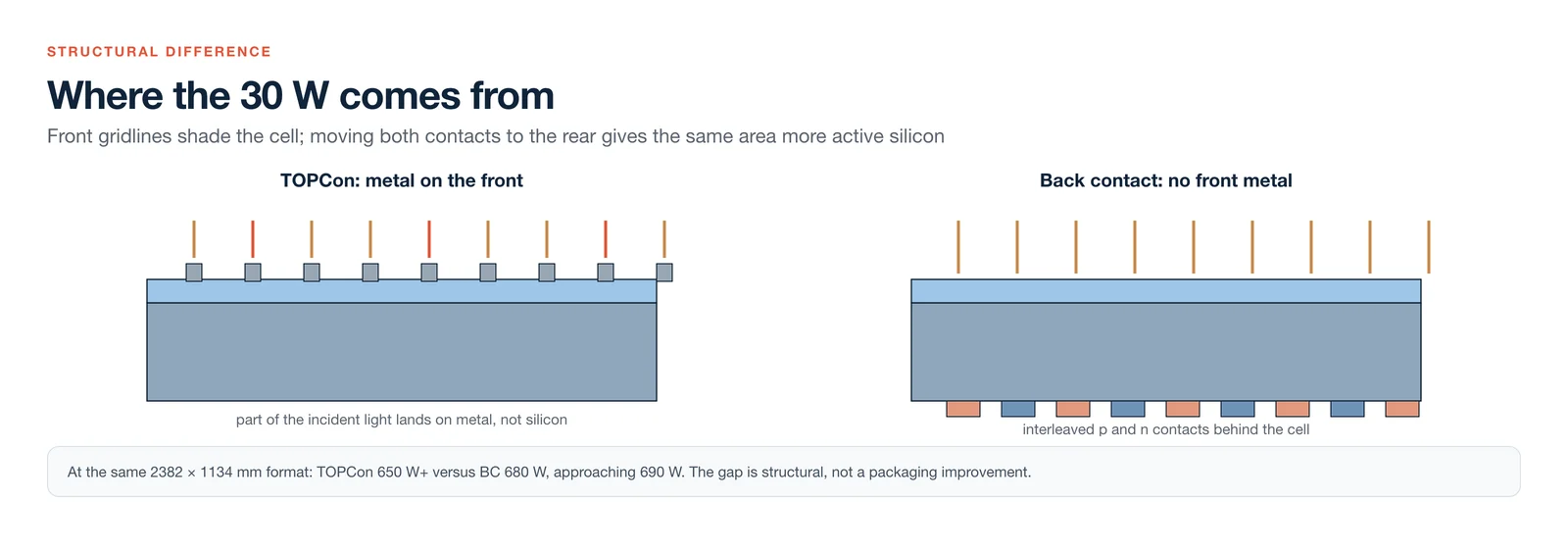
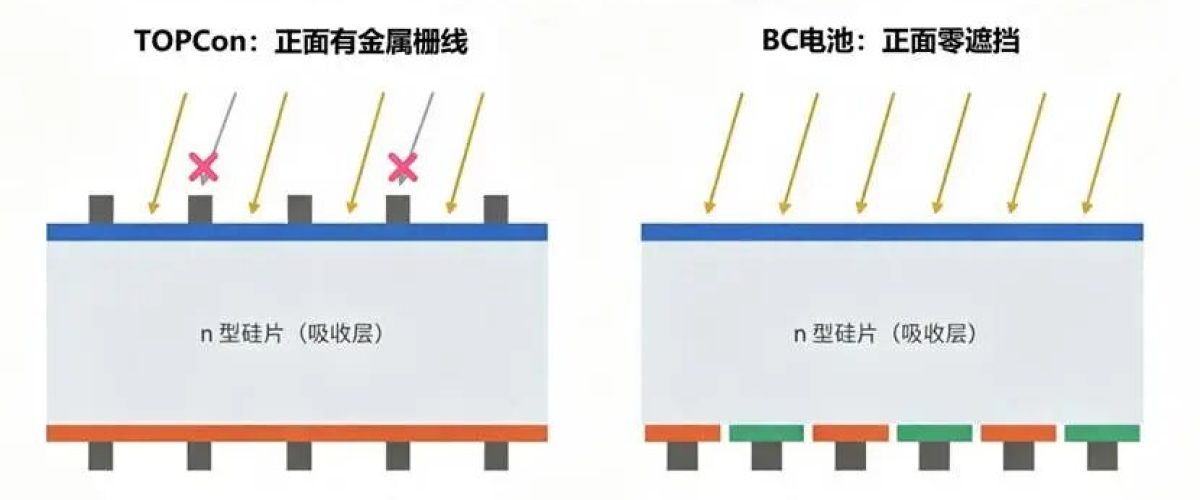
Back contact moves all metal electrodes to the rear, so the front has no shading at all. Under the same illumination the cell collects more photons — an optical structural gain that does not need the packaging side to compensate. TOPCon's front gridlines are structural too: the loss does not disappear because lamination improves, it is only partly masked by better current management.
Why TOPCon turned to quarter-cutting
Module power is roughly the cell efficiency times active area times the number of cells, minus module-level losses. TOPCon cannot move efficiency quickly and cannot recover the shaded area, so the only variable left is the loss term. Quarter-cutting attacks exactly that: with power loss proportional to current squared times resistance, going from half-cut to quarter-cut halves the current and cuts resistive loss by about 75%.
Note what does not change: cell efficiency, open-circuit voltage and passivation quality. It is a loss-recovery exercise — flow control rather than a new source of power.
But cutting is not free
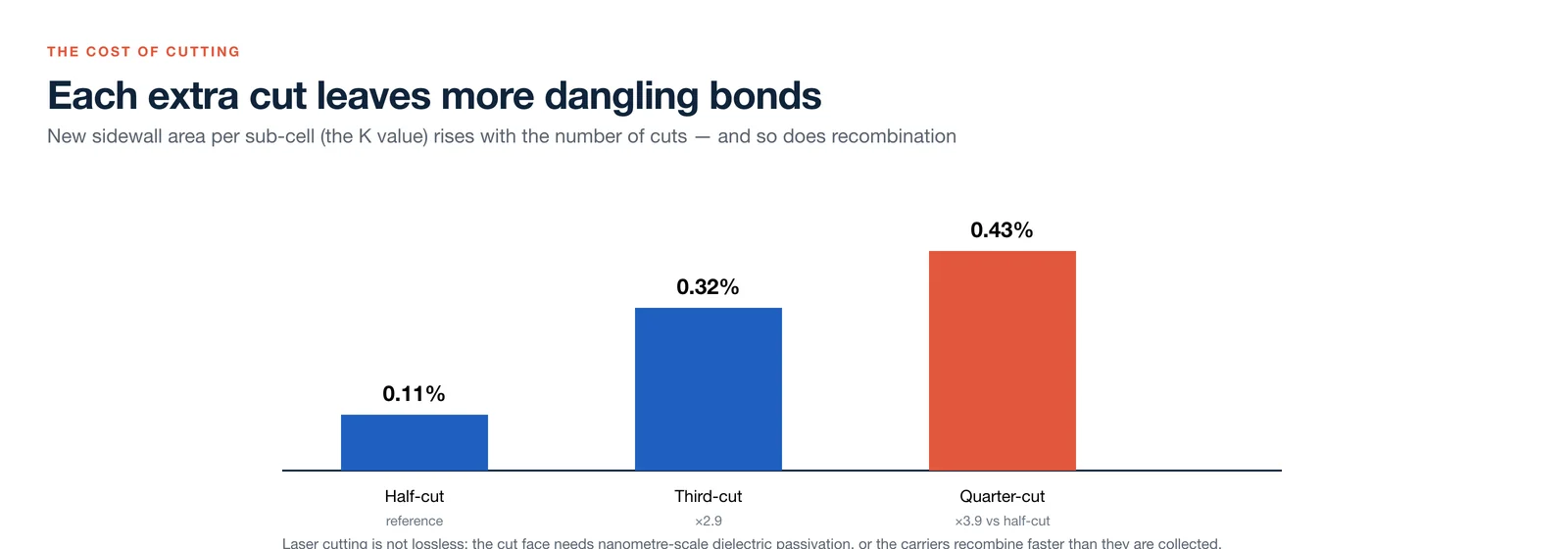
Laser cutting leaves dangling bonds along the cut face, and carrier recombination rises sharply. Research published in Advanced Energy Sustainability Research quantifies it with a K value — new sidewall area divided by sub-cell surface area — at 0.11% for half-cut, 0.32% for third-cut and 0.43% for quarter-cut, nearly four times the half-cut figure. The cut face cannot be left bare: it needs nanometre-scale dielectric passivation to repair those bonds. Cutting is the surgery; passivation is the skill, and not every manufacturer has it.
The cost is real too. A Hengdian DMEGC engineer put it plainly: quarter-cut modules are not yet in volume production and there will be a long ramp, because the cell equipment investment is significant. Another industry voice was more direct: the technology is not complicated, but yield is, the framing and equipment have to keep up, and with everyone losing money the investment is a problem. Moving from half-cut to third- or quarter-cut means systematic changes to laser scribing, stringing and lay-up equipment, plus lossless cutting, high-density encapsulation, a different series-parallel circuit and edge repair. The CPIA's annual report lists the shift as an industry trend — which is another way of saying the leaders can fund it and the middle of the market can only watch.
Why back contact does not need quarter-cutting
Quarter-cutting works just as well on back-contact cells; the BC camp simply does not use it. With no front gridlines, BC already has the largest active area, and the cell efficiency ceiling is higher — 28.29% has been certified. The incremental gain from more cuts is small, while the cost in laser steps, passivation, interconnection complexity and yield is not. For BC it is not that quarter-cutting cannot be used; it is that it is not worth using.
The capacity signal
| Company | BC capacity or plan |
|---|---|
| LONGi | HPBC 2.0 near 60 GW; intends to switch all domestic cell capacity to BC by end-2026 |
| Aiko | ABC target about 30–35 GW; converting PERC in Yiwu and TOPCon in Chuzhou |
| TCL Zhonghuan | Planned retrofit of 20 GW BC cells and 25 GW BC modules |
| GCL Integration | 7 GW BC module retrofit under way |
| Trina | Small-volume BC production in H2 2026 |
| Tongwei | Appearing in state-owned BC module tender packages |
| Chint | BC pilot line established |
| Jinko | Launched TAC modules, widely read as BC under another name |
Of the ten largest module shippers in 2025, only Hengdian DMEGC has not disclosed BC volume production. The ITRPV's 17th edition forecasts BC at about 28% of global market share over the next decade — notable because BC is the only one of the three n-type routes given its own ten-year forecast line.
A fair reading
The argument above comes from the source article and leans clearly towards back contact. Two qualifications are worth keeping in view. First, quarter-cutting is a genuine engineering response to a real constraint, and for utility tenders where module power is a bid criterion, closing the 30 W gap can be the difference between being shortlisted and not. Second, the 30 W matters to investors because it moves BOS cost per watt and therefore cash flow over 25 years — but it has to be weighed against module price, bifaciality, warranty and bankability, not against wattage alone.
How ZOEAST PV sees the choice
ZOEAST PV supplies both routes and does not treat either as a universal answer. For utility and commercial projects, our mainstream remains n-type TOPCon: better bifaciality, lower cost per watt and a mature supply chain. For premium residential and architectural work, BC's all-black front and higher efficiency justify the premium. Where a customer is comparing a 650 W TOPCon module with a 680 W BC module at the same format, we model both on the actual site — including bifacial gain and price — rather than comparing nameplate watts.
See the cell range, the colour modules for façade work, or send us your project parameters.
Data notes: module power figures follow Hengdian DMEGC's earnings-call statement and the source article; the quarter-cut loss model and the K values follow the cited research as summarised in the original article; capacity figures are company announcements as reported. The source article argues a BC-favourable position; this adaptation keeps that argument and adds the counter-considerations above. Figures: ZOEAST PV, redrawn in English from the original article.