
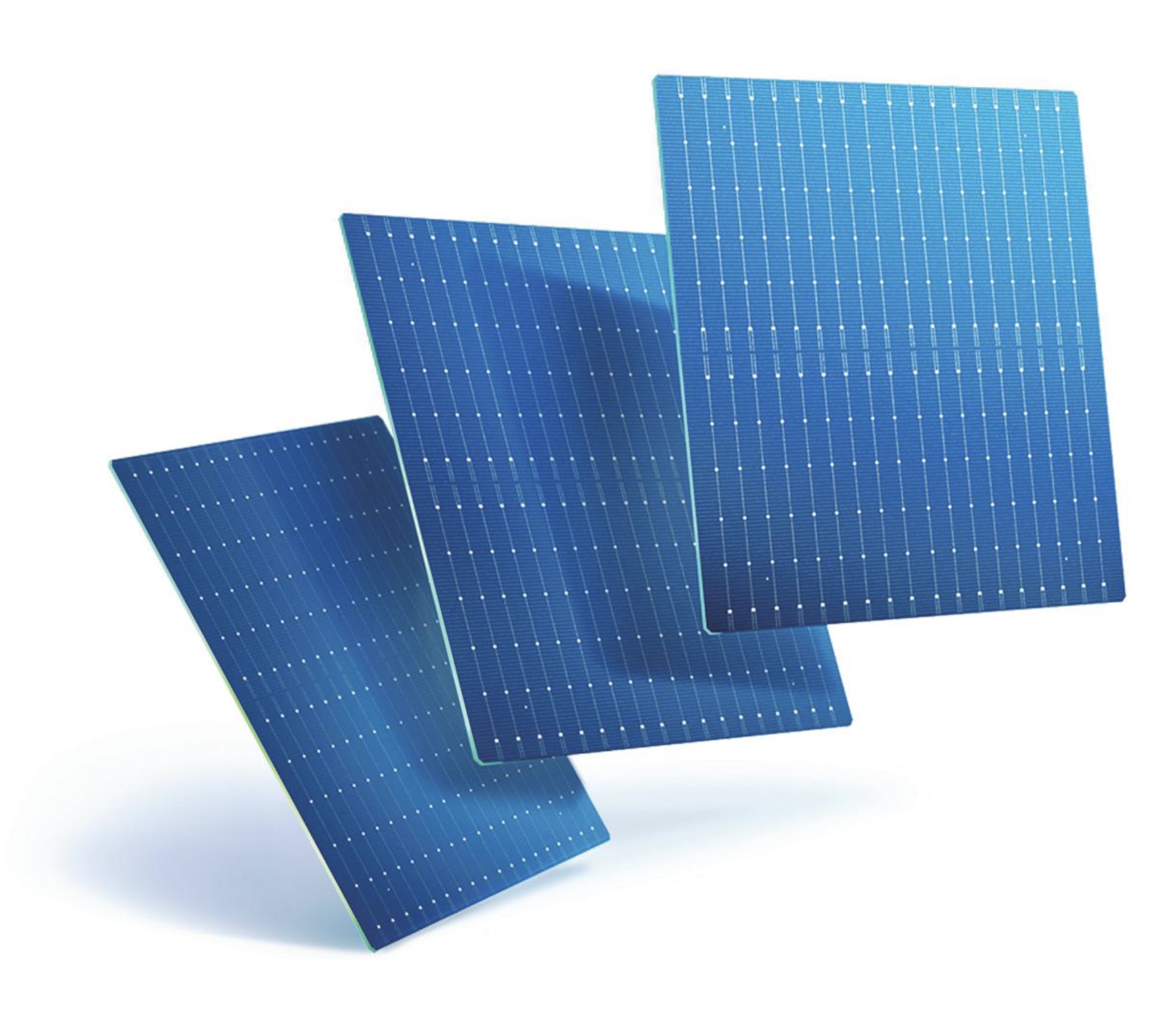
TOPCon and BC in 2026: what a module line should specify
Two cell routes now ship at volume. The difference that matters to a module maker is not the efficiency headline — it is the busbar count, the wafer thickness and what your stringer has to hold.
Editorial responsibility for this article rests with ZOEAST PV CO., LTD. See our editorial policy for how we write, where AI tools are used, and how to request a correction.
Both routes are buyable in 2026 and both will build a 24% module. TOPCon gives you 16BB or 18BB on M10 to M12 with a 130 μm wafer and the widest supplier base; back-contact gives you a grid-free front, one busbar count (18BB on M10R and M12R) and the best-looking panel. The purchasing questions are the same for both: which bin can be held for twelve months, what wafer thickness you are buying, and whether your stringer and laminator can run that busbar layout without a recipe change.
The two routes, in one table
Strip away the marketing and the two cell families differ in five places that a module line can feel:
| What changes | TOPCon | BC / TBC |
|---|---|---|
| Front side | Fingers and busbars on the front; shading loss remains | No front grid at all; all contacts on the rear |
| Busbar count | 16BB (M10 / M10R) or 18BB (M12) | 18BB on M10R and M12R |
| Wafer thickness | 130 μm ± 13 μm in current ranges | 150 μm on M6-class, 130 μm on M12-class |
| Process constraint | Firing step and rear passivation | More masks; rear isolation gap and leakage control |
| What it buys | Efficiency per yuan, widest supply base | Appearance, shade tolerance, premium roofs |
Those five rows decide more about your line than the efficiency figure on the front of a brochure does.
Why the efficiency headline is the least useful number
A cell datasheet can show a cell efficiency above 26% while the module built from it lands at 24%. The gap is glass, gaps, ribbon and the busbar area — none of which the cell datasheet knows about. When you specify, write down the module efficiency you will accept, then work backwards to the cell bin that gets you there with your own bill of materials.
A cell that gains 0.4 percentage points but needs a new stringer recipe, a different ribbon width and a second EL reference module is not a 0.4% gain. Cost the changeover before you cost the cell.
What to put in the specification
Four numbers belong in writing before any quotation is compared:
| Parameter | Why it goes in writing | Typical value to expect |
|---|---|---|
| Efficiency bin and tolerance | A bin you cannot hold for twelve months is a re-qualification every quarter | Agreed per order, with the binning report attached |
| Wafer thickness | Thinner cells change breakage at the stringer, not at the cell line | 130 μm ± 13 μm on TOPCon; 130–150 μm on BC |
| Busbar layout and pad count | Fixes ribbon width, stringer programme and pull-force target | 16BB / 18BB, 14 pads, 168–192 fingers |
| Temperature ceiling at stringing | Sets the soldering profile and the maximum ramp | Written limit with time above it, not a single number |
The fourth row is the one buyers forget. A soldering profile that runs 10 °C hot for two seconds is a different process from one that runs 10 °C hot for ten, and the datasheet rarely says which.
Where the silver goes, and why it moves your BOM
Metallisation is the largest non-silicon cost in a cell, and both routes are pushing it down. TOPCon has been moving from 12BB to 16BB and 18BB for exactly this reason: finer busbars mean less silver per watt and a shorter current path. Back-contact removes the front grid entirely but concentrates more metal on the rear, where the isolation gap has to be controlled.
For a module maker the practical consequence is that ribbon supply is now a busbar decision, not a purchasing afterthought. If the cell supplier moves from 16BB to 18BB between your qualification run and your volume order, your ribbon width and your stringer programme both change. Ask for the busbar layout in the same document as the price.
Thin wafers are a handling problem before they are a cost problem
A 130 μm cell is not a 150 μm cell that weighs less. It bends further under the same suction, stores more elastic energy before it breaks, and it fails at the edge rather than in the middle. The breakage you get is set by how the cell is picked, flattened and released — that is the stringer and the layup, not the cell line.
If a supplier quotes a thinner cell without a breakage figure measured on a stringer at that thickness, the quote is missing its largest downstream term. Measure it on your own line during the sample run, and write the number into the acceptance criteria.
What this means for the panel you sell
The two routes end up in different products more often than they end up competing:
- TOPCon goes into mainstream rooftop and utility modules where W per yuan decides the order.
- Back-contact goes into all-black residential and visible-façade work, where a uniform front is worth more than the last 0.3%.
- Coloured and BIPV builds take either cell, but the glass decision usually dominates the outcome.
The bottom line
In 2026 the route question is settled by your product, not by the technology. Choose the cell your line can run without a changeover you have not costed, fix the four numbers above in writing, and buy the bin rather than the record.
Frequently asked questions
Is TOPCon or BC better for a new module line?
TOPCon has the wider supplier base and the simpler changeover from PERC; BC buys appearance and shade tolerance at the cost of more rear-side process control. Decide from the product you intend to sell, not from the record efficiency.
Can one stringer run both?
Sometimes. The frame is the easy part — what changes is the soldering profile, the ribbon width and the handling force. Ask for the changeover list and the time it takes, not for a yes.
What busbar count should I specify?
Match it to what your cell supplier actually runs and to the ribbon width your stringer handles. 16BB and 18BB both ship today; mixing them across a qualification and a volume order is the expensive mistake.
How thin a wafer can my line take?
It depends on your handling, not on the cell. Ask the cell maker for the breakage it measured on a stringer at that thickness, then measure it yourself on the sample run.
Does the cell efficiency on the datasheet equal module efficiency?
No. Module efficiency is lower by the glass, the gaps, the ribbon and the frame. Specify the module number you will accept and work back to the cell bin.
What should be in the datasheet package?
The bin, the busbar layout, the wafer thickness with tolerance, the temperature coefficient, the IV test conditions and the binning report for the batch you are buying.
Where these numbers come from
Cell dimensions, thickness and busbar layouts in this article come from ZOEAST's current cell specification sheets for the TOPCon M10, M10R and M12 formats and the BC M6, M10 and M12 formats.
Module-level figures (ZEM-510-108BC at 480–510 W and up to 24.98% module efficiency) come from the published datasheet for that series.
Standards references (IEC 61215, IEC 61730, IEC TS 62915) are cited by designation only. Nothing in this article is a price, a lead time or a delivery commitment.

Need a specification and a price?
Send the model, quantity and destination port — we come back within 24 hours with datasheet, packing data and lead time.