
The encapsulant film is the least visible component in a solar module and one of the two or three that decide how long it lasts. It sits between the glass and the cells, bonds the stack together, lets light through and blocks water vapour. Choose it badly and the failure mode is not a bad flash test — it is a module that loses power in year six, or one that has to be replaced under warranty in year twelve.
Three films dominate the market: EVA, POE and EPE. They are not interchangeable, and the price gap between them is smaller than the cost of getting it wrong.
What an encapsulant actually has to do
Three jobs, in order of difficulty:
- Bond glass, cells, ribbon and backsheet into a single laminate that survives 25 years of thermal cycling.
- Transmit light with minimal loss and without yellowing.
- Block water vapour and ions, so the cell surface and the metallisation do not corrode.
Every film trades these against cost and processability. That trade is what separates the three products.
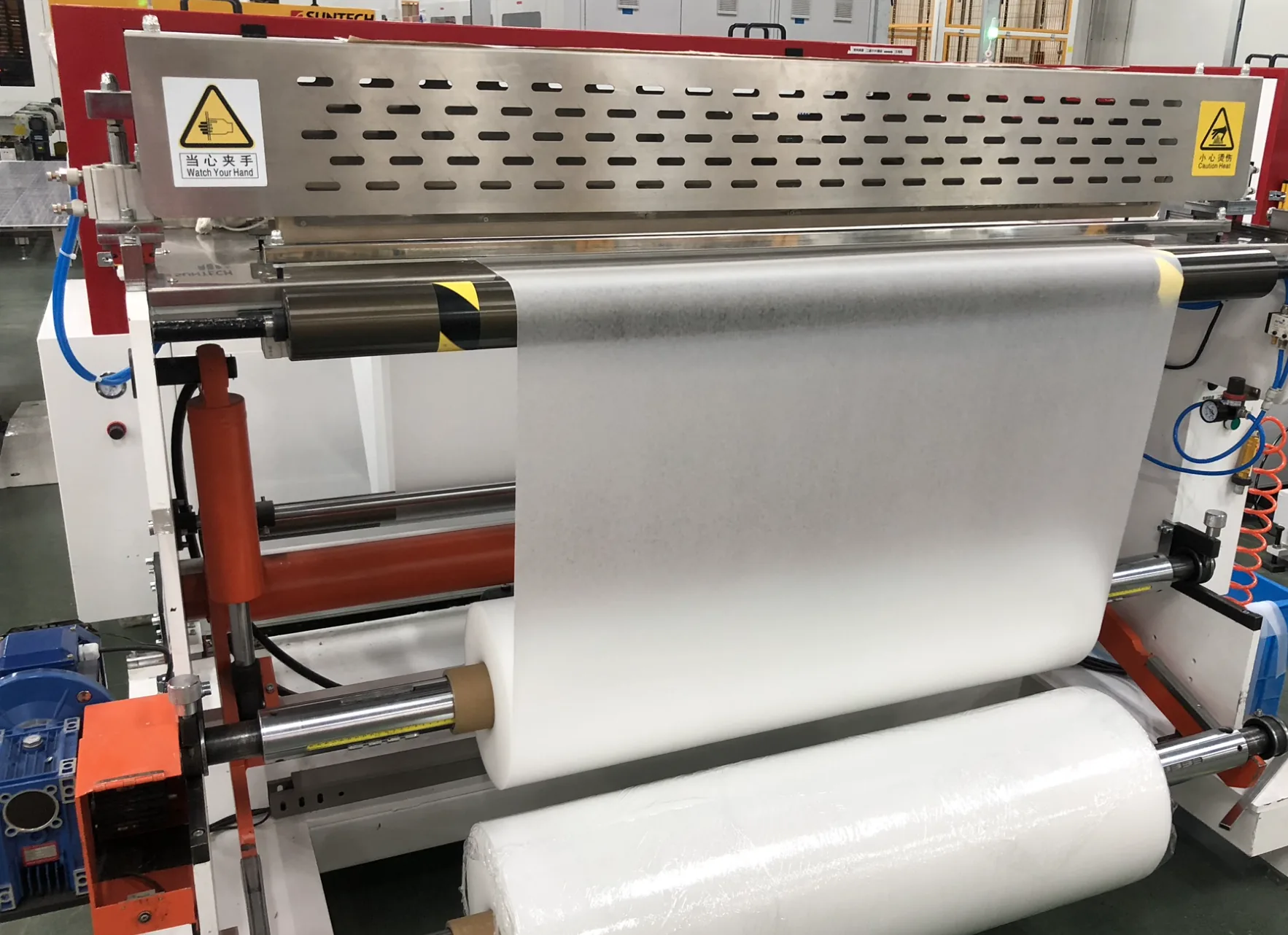
EVA: the incumbent
Ethylene-vinyl acetate is the industry veteran and still the highest-volume film. Its adhesion to glass, cells and backsheet is excellent — close to a universal glue for module stacks. It melts at a low temperature, so lamination is forgiving and thin cells are less likely to crack. And it is cheap: roughly 60–70% of the cost of POE.
The weaknesses are equally well known. EVA has a relatively high water-vapour transmission rate — around eight times that of POE. Under damp heat and UV it degrades faster. Most importantly, EVA hydrolysis releases acetic acid, which can corrode the cell metallisation and the ribbon over time. This is why EVA modules in hot, humid locations show higher rates of power loss and, in the worst cases, snail trails and grid corrosion.
Where EVA still wins: large ground-mount plants where cost dominates and climates are dry and temperate; conventional single-glass monofacial modules; p-type PERC products with a mature bill of materials. With good process control and periodic O&M, EVA comfortably meets a 25-year service life in those conditions.
Where to be careful: hot and humid regions, bifacial glass-glass construction, and n-type TOPCon or HJT cells. All three amplify the moisture and acetic-acid problem.
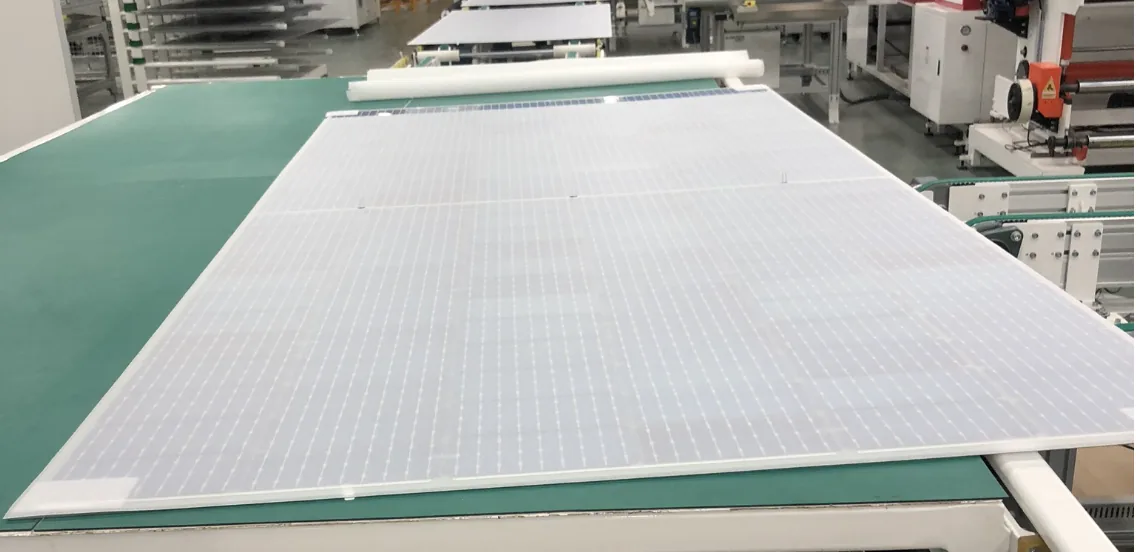
POE: the barrier specialist
Polyolefin elastomer has no hydrolytically unstable ester bonds in its molecular chain. The consequences are exactly what you would want: extremely low water-vapour transmission, high volume resistivity, strong resistance to potential-induced degradation (PID), and good resistance to hydrolysis, UV and ozone. In hot, humid and high-voltage-stress sites it is the most reliable film available.
It is also the most expensive, and it is slippery. During lamination, POE has a narrower process window: ribbon and cells shift more easily, so the layup and the lamination recipe have to be tighter. That is a process problem, not a performance problem — but it is real, and it shows up in yield.
Where POE wins: bifacial glass-glass modules, where both faces are protected by film and moisture has nowhere to escape; n-type TOPCon and HJT cells, which are more sensitive to PID and damp-heat degradation; coastal, humid and rainy distributed projects.
EPE: the compromise that became mainstream
EPE is a three-layer co-extruded film: EVA on both faces, POE in the middle. The outer EVA layers provide adhesion and process familiarity; the POE core provides the moisture barrier and PID resistance. It captures most of POE's reliability at a lower material cost and with an easier lamination window than pure POE.
The market has voted. EPE's share of the encapsulant market grew from roughly 9% in 2020 to about 28% in 2024, making it the second-largest film category after transparent EVA.
Where EPE wins: high-volume n-type module production that needs reliability without a POE price; ground-mount and distributed projects in mixed or difficult climates; glass-glass bifacial modules, often paired with EVA as a cost-optimised combination.
The caveat is manufacturing discipline. Co-extruding three layers to consistent thickness and adhesion is harder than making a single-layer film, and interlayer delamination is a real failure mode if the supplier's process drifts. When qualifying EPE, audit the extrusion line, not just the datasheet.
Side by side
| Property | EVA | POE | EPE |
|---|---|---|---|
| Water-vapour transmission | High (~8× POE) | Very low | Low (POE core) |
| PID resistance | Moderate | Excellent | Very good |
| Adhesion / lamination window | Excellent | Poor (slippery) | Good |
| Acetic acid generation | Yes, under hydrolysis | No | Limited to outer layers |
| Relative cost | Lowest | Highest | Middle |
| Best fit | Dry, temperate, cost-driven | Humid, coastal, glass-glass, n-type | High-volume n-type, mixed climates |
Selection by scenario
| Project scenario | Recommendation | Reason |
|---|---|---|
| Conventional single-glass monofacial, dry climate | EVA | Lowest cost, adequate life |
| Coastal, humid or rainy distributed rooftop | POE | Moisture and PID protection |
| Bifacial glass-glass, n-type TOPCon or HJT | POE or EPE | Both faces sealed; PID-sensitive cells |
| Complex climate, cost-constrained utility project | EPE | Best performance-to-cost ratio |
| Building-integrated PV | Consider PVB | High adhesion and impact resistance |
What to ask a supplier
Datasheets rarely separate good films from mediocre ones, so ask for the test evidence behind the claims:
- Water-vapour transmission rate at 38 °C/90% RH, with the test method stated.
- Volume resistivity — the number that predicts PID behaviour at system voltage.
- PID test results to IEC 62804 at module level, not cell level.
- Peel strength to glass and to backsheet, before and after damp heat.
- Gel content and cross-linking density, which tell you whether the lamination recipe is under control.
- Batch-to-batch thickness and adhesion consistency — the failure mode that shows up only at scale.
There is no "best" film. There is EVA for cost, POE for barrier performance and EPE for the balance between them. Match the film to the climate, the module construction and the cell technology, and a 25-year warranty becomes an engineering statement rather than a marketing one.
ZOEAST PV supplies glass-glass and single-glass modules with EVA, POE or EPE encapsulation specified per project — see the module range or send us your site conditions for a recommendation.
Photos: from the original article.