Ask anyone in the Chinese PV industry whether the year will end better than it started and you get the same nervous pause. This article is one observer's answer, written in early October: the price floor is probably in, but a recovery is not.
It is worth stating up front that everything below is an opinion built on public data, with the author's own estimates of ranges and probabilities. It is not investment advice, and we are republishing the argument because it shapes how buyers and suppliers should plan the next two quarters.
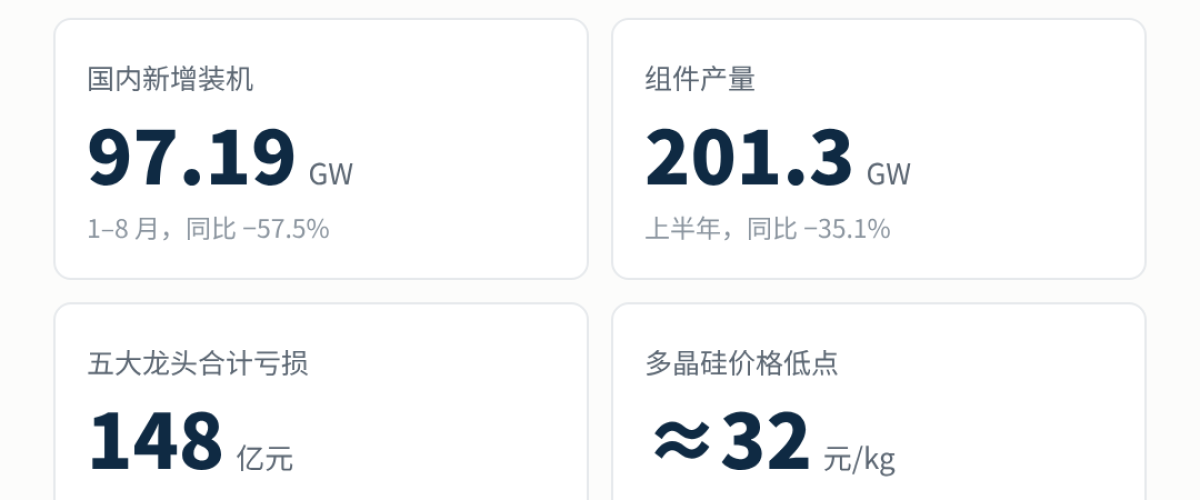
The year in four numbers
down nearly 60% year on year
the steepest fall in the chain
flat year on year, negative after July
Tongwei, LONGi, Jinko, JA, Trina
Demand, output, profit and price all fell together. On the domestic side, installations in January–August reached 97.19 GW, down almost 60% on the same period last year, because the rush to beat last year's electricity-market reform pulled demand forward. On the export side, the VAT export rebate on PV products was withdrawn from 1 April; March exports spiked to a three-year monthly high and then fell back. With both ends squeezed, module output fell 35.1% in the first half — the biggest drop anywhere in the chain — and the five largest manufacturers lost a combined CNY 14.8 billion.
Three signs that the worst is passing
Domestic installations turned positive. June to August added 37.6 GW, up 14.8% year on year, with August alone up 50%. Part of that is a weak base, but it does show demand has stopped falling.
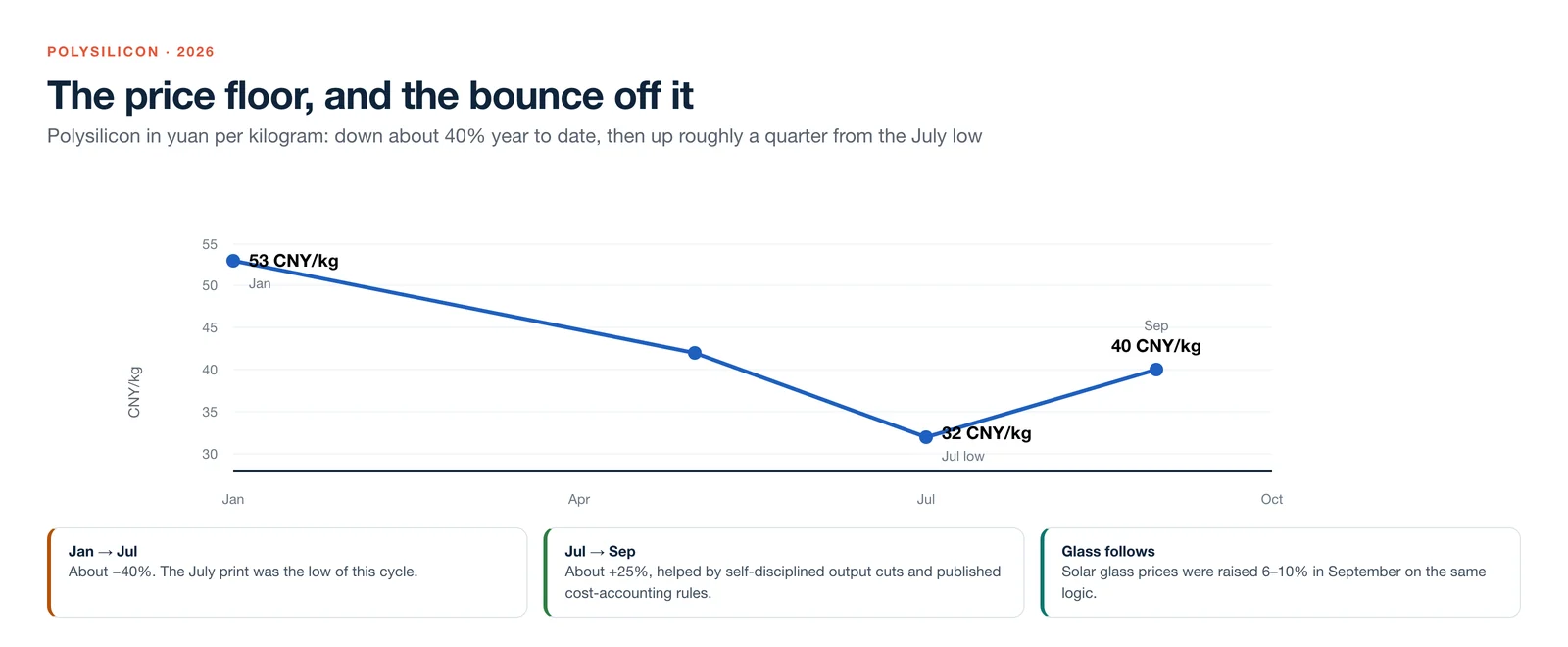
Prices climbed out of the hole. July was the low of this cycle, with polysilicon near CNY 32/kg — about 40% below the start of the year. Self-disciplined output cuts and the publication of cost-accounting rules lifted it back to about CNY 40/kg by September, a gain of roughly a quarter. Solar glass followed with a 6–10% increase in September.
The financials improved at the margin. Losses are still large, but operating cash flow at several leaders has turned positive, LONGi's second-quarter gross margin returned to 3.13%, and Trina was marginally profitable in the quarter. These three signals say "no longer getting worse" — not "getting better".
Three rocks still in the way
1. The price rise is not passing through. This rally started at polysilicon, driven by output discipline rather than demand. At the module end, state-owned tender buyers are squeezing prices and end customers are waiting: mainstream quotes sit at CNY 0.69–0.71/W and were softening again in late September. Chinese TOPCon module prices in Europe are also weakening, while silver paste costs keep rising. Cell and module makers are caught in the middle — costs up, prices flat. The sector index fell about 15% in the quarter, underperforming the wider market.
2. There is no new demand. CPIA's opening forecast for 2026 was 180–240 GW of domestic additions. To reach even the bottom of that range, September to December would need about 83 GW — roughly what was installed in the same period last year. From the June–August run rate that is reachable, but only just. Overseas, the cost increase from the rebate removal is still being absorbed, India has required domestic cells for grid-connected projects since June (Chinese cell exports to India fell more than 80% month on month), and US and European barriers keep tightening. Holding export volume flat would be an achievement; expecting growth is not realistic.
3. Capacity has stopped, not exited. Polysilicon utilisation is expected to fall to about 35% from October, and the chain average is below 40%. Prices are being held up by everyone producing less — but the lines still exist. As soon as prices return to a profitable level, restart pressure returns; October already brought reports of two restarts against six cuts. What might force real exits are the three mandatory national standards taking effect on 1 January 2027 (energy consumption limits for polysilicon and monocrystalline silicon, and efficiency thresholds for modules and inverters), plus the cost-accounting model published in July, which gives regulators a basis for identifying below-cost selling. The tools exist; how hard they are enforced becomes clear next year.
The author's base case: three phases in six months
| Window | What happens | What to watch |
|---|---|---|
| Oct–Nov | Stand-off. Polysilicon holds near CNY 40/kg on output cuts; downstream buys only what it needs. Module prices drift around CNY 0.70/W. | Actual polysilicon output, not the quoted price |
| December | Good data, flat prices. Year-end grid connection pushes a single-month installation peak; full-year domestic additions land at 180–195 GW. | Whether the year-end volume can support a module price rise (the author thinks not) |
| Jan–Mar 2027 | Verification. Low season plus Spring Festival cuts demand; the question is whether non-compliant capacity really exits once the standards bite. | Whether prices hold through a seasonally weak quarter |
In short: better than the first half, but only modestly. The industry is moving from bleeding to stanching the wound — not yet to making blood.
Six things to watch
- Actual polysilicon output in October–November — whether it really falls to about 105,000 tonnes a month, which is the floor under the whole price chain.
- Winning bid prices in state-owned module tenders — whether CNY 0.70/W holds. If it does not, the upstream rally will be given back.
- November–December installation data — the quality of the year-end grid connection decides whether 2026 lands at 180 GW or 200 GW.
- Q3 reports in late October — look at gross margin and operating cash flow sequentially, not at net profit.
- Enforcement detail after 1 January: inspections, public notices, actual shutdowns.
- Provincial 2027 mechanism-price auctions, which set the ceiling for next year's domestic demand.
What it means if you are buying modules
- Price floor, not price recovery. With module prices stuck near CNY 0.70/W while polysilicon and silver rise, expect margin pressure to show up as commercial behaviour: squeezed warranties, slower service, thinner BOMs. Read the bill of materials, not just the quote.
- Capacity is idling, not leaving. Delivery dates can move quickly in either direction when lines restart or stop; qualify a second source while the market is soft.
- The standards are the real event. From January 2027, efficiency and energy-consumption thresholds turn "cheap" modules into non-compliant ones. Specifying to the new thresholds now avoids being stuck with inventory that cannot be bid into projects later.
How ZOEAST PV is positioned
ZOEAST PV buys cells and sells modules into this market, so the squeeze is familiar: input costs moving up while tender prices stay flat. Our response has been to keep the product range on standard, compliant specifications rather than chasing the lowest quote of the month — 425–650 W n-type TOPCon modules on two automatic lines in Yixing, with cells from our own 5 GW of capacity where the specification allows it.
For customers planning 2027 projects, the practical offer is a price and availability view that includes the standards transition, not just today's number. Send us your project parameters and we will quote against the specification you will actually need to bid, and see the module range for current formats.
This article is an English adaptation of a Chinese market commentary published in October 2026. The judgements, price ranges and probabilities are the original author's opinion, not investment advice. Data points follow National Energy Administration statistics for January–August 2026, 21st Century Business Herald reporting, Tencent News coverage of H1 results, CPIA forecasts and InfoLink spot pricing. Figures: ZOEAST PV, redrawn in English from the original article.