With aluminium above CNY 23,000 per tonne and frame processors squeezed to the point of losing money on the conversion fee, steel frames are back on the agenda. China has reached "standard plus project-level batches". The United States has reached gigawatt-scale supply agreements. Neither is close to being the mainstream.
This is not a concept article. It answers three questions: how far has steel-frame production actually got, what is blocking it, and which segments will scale first.
The headline: loud, but small
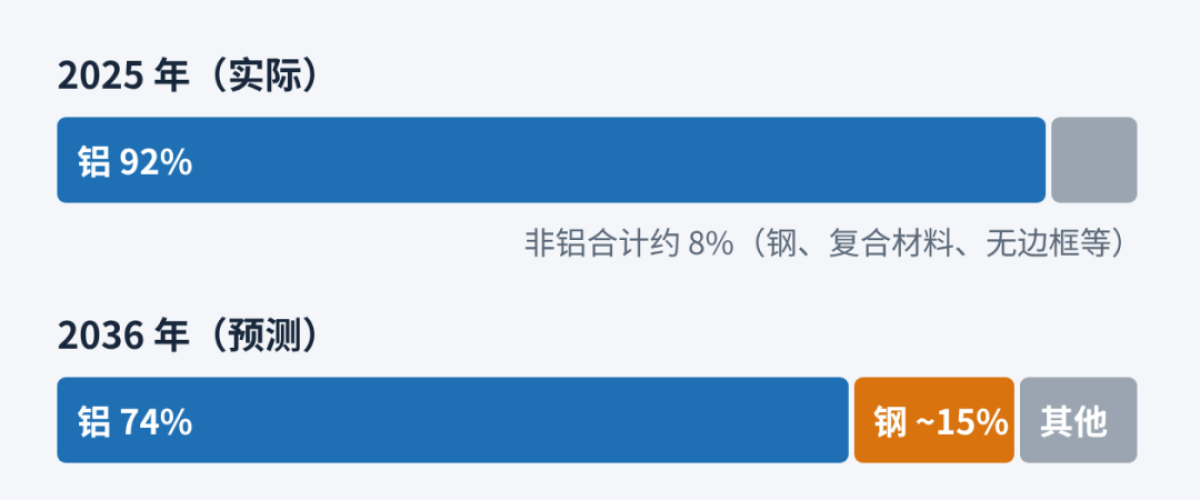
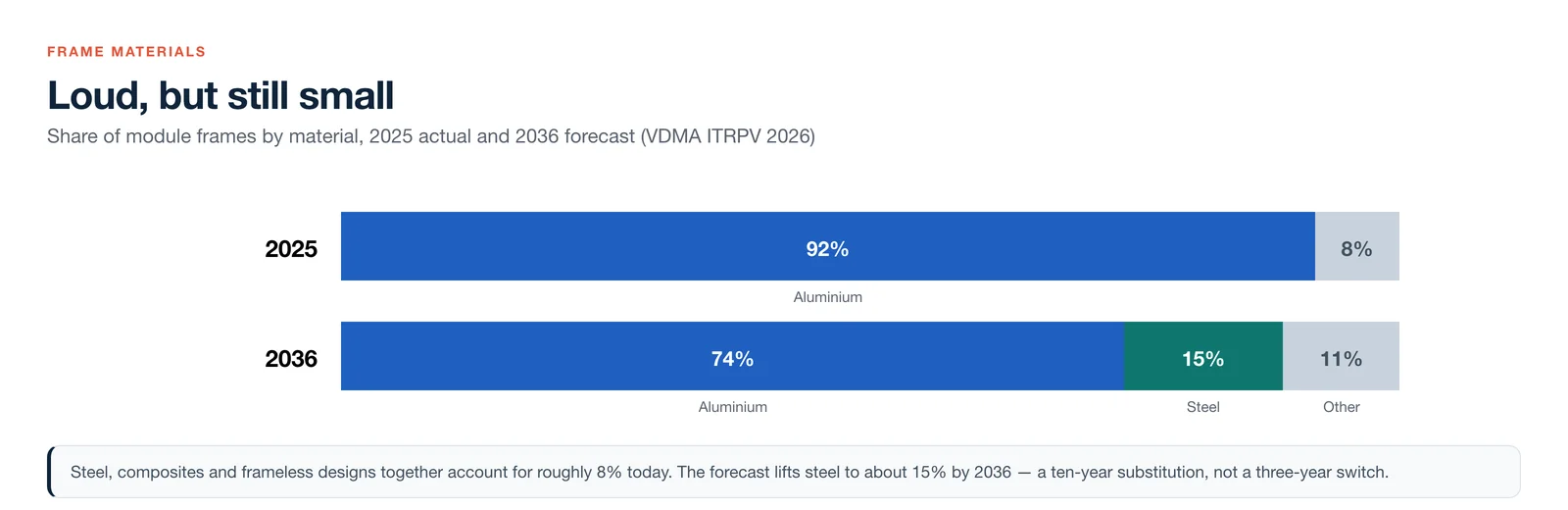
By any measure, aluminium still owns the frame. SMM and several brokerages put aluminium's share above 95%; the VDMA ITRPV 2026 report says 92% of modules globally used aluminium frames in 2025, which leaves steel, composites and frameless designs with roughly 8% between them.
Why this round of discussion is more serious
The frame is one of the highest-value auxiliary materials in a module. On 2023 numbers an aluminium frame cost about CNY 0.10/W, more than 9% of module manufacturing cost, and its cost structure is rigid: the ingot is around 82% of the cost, and pricing is "ingot plus conversion fee", so the only negotiable line is the fee.
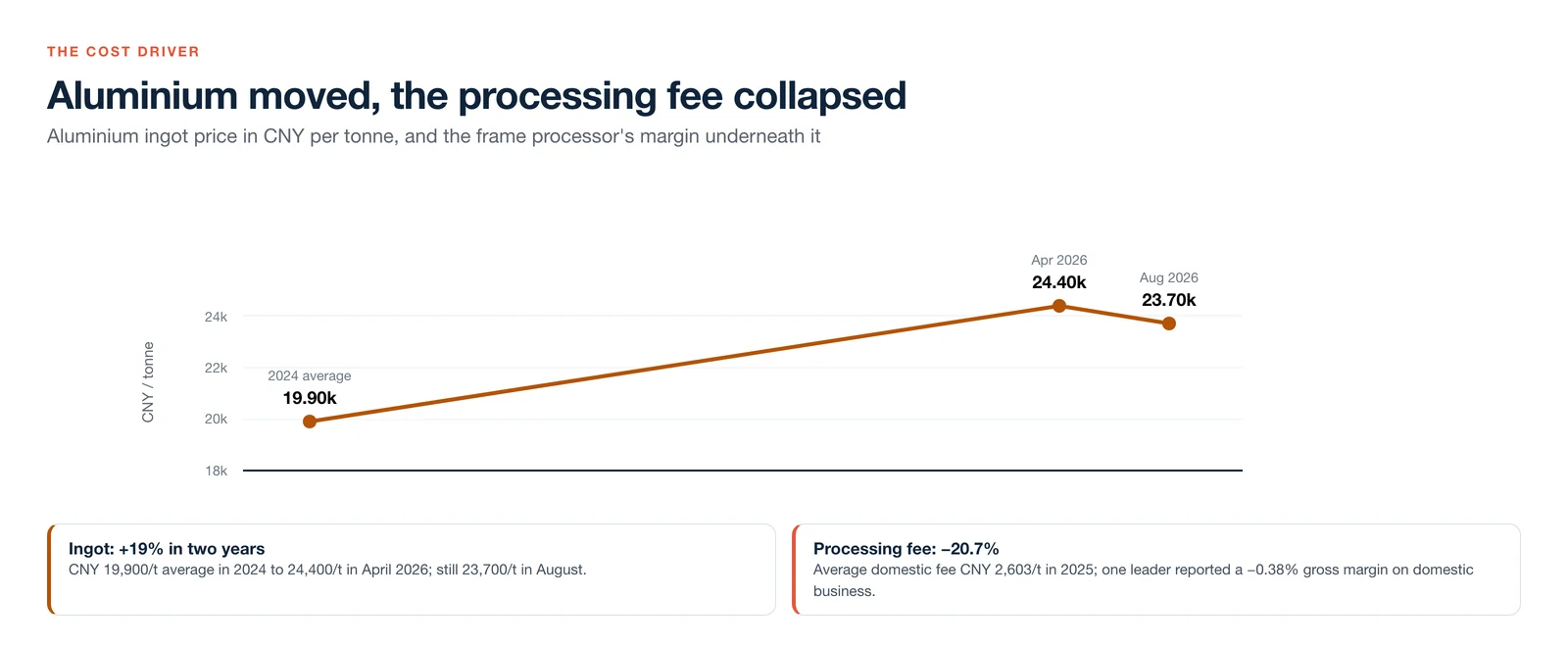
The fee has been squeezed hard. Yongzhen, one of the largest frame makers, disclosed in a June 2026 filing response that the average domestic processing fee in 2025 was CNY 2,603/t, down about 20.7%, with a gross margin of −0.38% on domestic business and some quotes at or below cost. Xinbo, another leader, also lost money in 2025.
With the fee exhausted, the only remaining lever is material. Aluminium consumption has already fallen from about 0.5万吨/GW in 2023 to 0.45–0.48万吨/GW, while modules keep getting larger. Thinner profiles and bigger modules leave less mechanical margin — which is precisely the opening the steel camp uses.
What a steel frame actually is
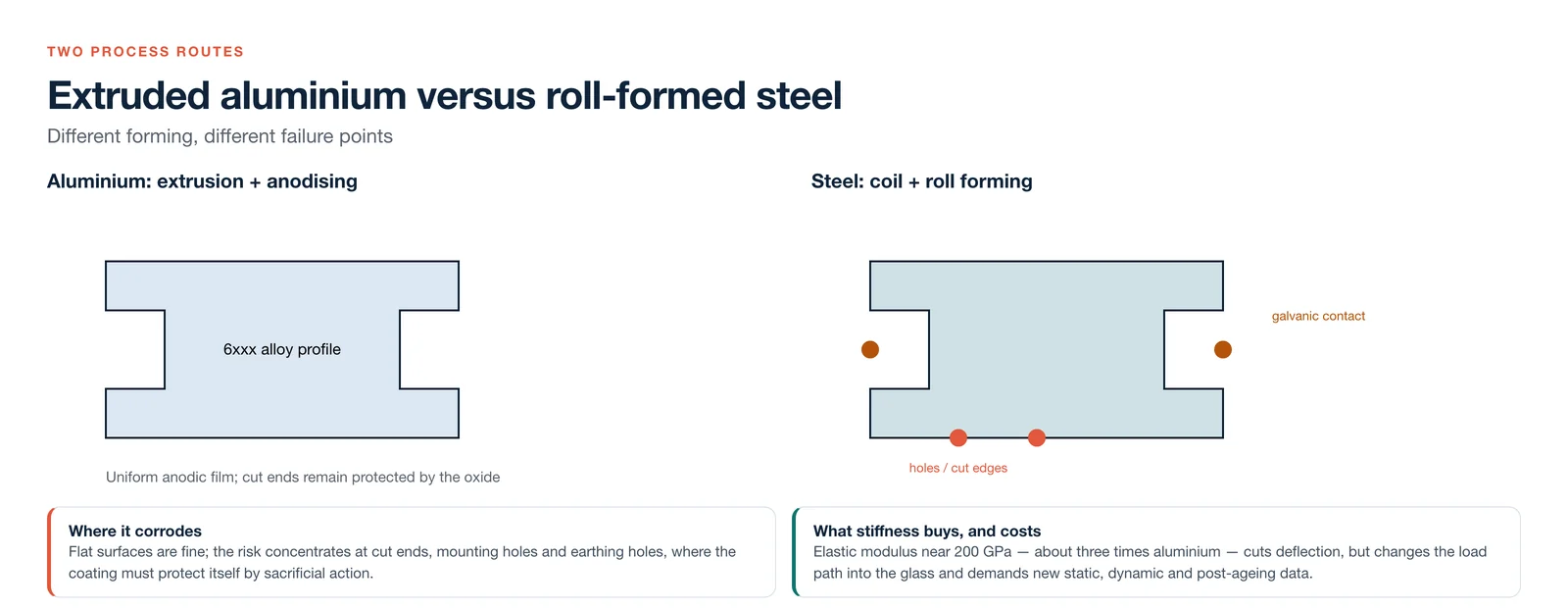
The industrial route is Zn-Al-Mg (ZAM) high-strength steel coil, continuously roll-formed: the coil is slit, bent through dozens of roll stations into a closed or semi-closed profile, cut to length, punched, and joined at the corners with corner keys. It shares nothing with aluminium extrusion, anodising and corner cutting except the function.
| Aluminium frame | Steel frame (Zn-Al-Mg) | |
|---|---|---|
| Forming | Extrusion + anodising | Coil slitting, roll forming, punching |
| Material strength | 6xxx series alloy | S550GD class, yield ≈550 MPa (maker data) |
| Stiffness | Modulus ≈70 GPa | ≈200 GPa, about 3× aluminium |
| Weight per module | Baseline | +2–2.5 kg |
| Corrosion protection | Anodic film, uniform | Coating; cut ends and holes are the weak points |
| Carbon footprint | High energy electrolysis | Makers claim >80% lower than aluminium |
| Scrap value | High | Clearly lower |
The strength, stiffness and footprint figures come from published statements by makers including Znshine, Chint and Nextpower; they are vendor claims without a common third-party comparison.
Where production actually stands
China: standards in place, project-level volumes
The accurate summary is: a standard, products and projects — but no public gigawatt-scale annual shipment figure. The China PV Industry Association published T/CPIA 0080-2024 for Zn-Al-Mg steel frames in August 2024. The drafting list is itself an industry map: frame makers, module makers including JA Solar, Chint and GCL, steel mills including Baosteel Zhanjiang and Baosteel's central research institute, plus tracker and owner representatives.
Usefully for specification, the standard ties coating weight to corrosivity category: 275 g/m² for C4 and below, 300/350 g/m² for C5, and 400/450 g/m² for CX. It also requires at least 4,000 hours of neutral salt spray without red rust, 20 ammonia cycles, less than 10% mechanical degradation after 1,000 hours of damp heat, and corner keys no less corrosion-resistant than the profile.
| Date | Milestone |
|---|---|
| Aug 2024 | China: T/CPIA 0080-2024 published — Zn-Al-Mg steel frame standard |
| 2023 | China: first project-level purchases (Zhonglai and others from Huishan) |
| 2025 early | China: Chint supplies 240 MW of steel-frame modules to the Jiuquan Jinta project |
| 2025 | China: Baowu 42 MW rooftop projects at Zhanjiang and Baoshan |
| Feb 2025 | US: Origami Solar starts steel-frame production in Arkansas |
| Sep 2025 | US: Nextracker (now Nextpower) acquires Origami Solar |
| 2026 | US: T1 Energy, Jinko US and Thornova sign; Jinko Florida contract is three years, >1 GW by mid-2026, scaling to 3 GW |
One pattern is worth noticing: the owners of China's first hundred-megawatt projects are steel companies themselves. Jiuquan and Baowu are both material suppliers and project owners, which makes them natural first adopters — and also shows that acceptance by third-party owners has not yet arrived.
The United States: gigawatt contracts first
The only gigawatt-scale contracts are American. Origami Solar started production in Arkansas in February 2025 and was acquired by tracker maker Nextracker (now Nextpower) in September 2025. T1 Energy, Jinko US and Thornova have since signed; Jinko's Florida agreement runs three years, delivering more than 1 GW by mid-2026 and scaling towards 3 GW.
The US got there because the commercial conditions differ, not because the technology is more mature: import duties on steel and aluminium, domestic-content credits that reward local material, almost no scaled aluminium extrusion capacity for PV in the US, and tracker makers integrating frames themselves. None of those conditions exist in China, so the US trajectory cannot be copied directly.
Five things standing in the way
- Corrosion at coating damage. Flat-surface performance is not in dispute; cut ends, punched holes and bends are. The coating protects itself by sacrificial action and corrosion-product sealing, and how well depends on sheet thickness, coating weight and environment. Brokerage reports flag earthing holes as prone to rust and hard to guarantee for 25 years. Galvanic corrosion where steel meets aluminium clamps and stainless fasteners needs separate assessment in wet or saline conditions.
- The lifetime argument, with data missing on both sides. The aluminium camp says steel frames last 10–15 years; the steel camp says 25–30 in C5. Both are positional. Salt-spray hours are accelerated tests that cannot be converted directly to outdoor years, and China's earliest volume applications date from 2022–2023, so there are only three or four years of field data.
- Weight. Adding 2–2.5 kg per module is modest for a ground mount and material for a commercial roof with little load margin, or for residential installers carrying modules by hand.
- Stiffness cuts both ways. Steel's modulus is about three times aluminium. Nextpower argues deflection falls to about a third, reducing glass breakage risk; Chinese brokerage reports warn that a stiffer frame deforms differently from the cells and could crack them. Both can be true: the load path and stress concentrations change with the section design, the sealant and the mounting method, which is why static, dynamic and post-ageing data matter.
- Process precision and supply-chain habit. Roll-formed parts spring back; dimensional tolerance, corner gaps and corner-key pull-out force all affect automatic framing yield. Aluminium also has a mature scrap-recovery market and a higher residual value. And "aluminium alloy frame" is still a default clause in many technical specifications from banks, insurers and owners — changing that clause is slower than changing the material.
The arithmetic, with caveats
A rough calculation, for order of magnitude only. Aluminium: 4.5–4.8 g/W × (CNY 23,700/t ingot + 2,600/t conversion) ≈ CNY 0.12/W. Steel, for a 600 W module: aluminium frame about 2.8 kg, steel about 5 kg after the weight increase, roughly 8.3 g/W; assuming a finished price of CNY 7–9/kg, that is about CNY 0.06–0.075/W. The difference is around CNY 0.045–0.06/W.
With module margins measured in cents, four to six cents per watt is attractive — and larger than the 20–30% saving claimed in 2023, simply because aluminium has risen since. But the comparison excludes the hidden costs: retesting and certification, framing-line modification and yield ramp, transport and installation weight, the lower residual value, and above all the warranty risk if a batch corrodes. Real net benefit will be materially smaller, and if aluminium falls back, it narrows further.
Which segments scale first
| Segment | Outlook | Why |
|---|---|---|
| US-made modules | Already scaling | Tariffs, domestic-content credits, little US aluminium extrusion |
| Steel makers' own plants | Early deployments | Jiuquan, Baowu projects where the owner is the material supplier |
| Desert and tracker plants | Most likely next | Dry, low-corrosion, high wind load suits stiffness; weight is not critical |
| Commercial rooftops | Depends on load margin | +2–2.5 kg per module matters |
| Residential | Slower | Manual handling, weight and appearance |
| Coastal, floating, offshore | Caution | CX corrosion class needs the highest coating weight; composites may fit better |
And there is a third competitor: composite frames. More than twenty suppliers of glass-fibre reinforced polyurethane frames exhibited at SNEC 2026, selling light weight, insulation and salt-spray resistance. The likely outcome is not steel replacing aluminium but aluminium dominant with steel and composites taking defined segments.
Three variables will set the pace in China: whether aluminium stays above CNY 23,000/t; whether a leading module maker puts steel frames into a standard BOM rather than project-specific orders; and what the cut ends and earthing holes look like after three to five years in the field. The last is the most important and the least hurry-able.
An import checklist for material and process engineers
| # | Validation item | Detail |
|---|---|---|
| 01 | Specification selection | Base steel grade, sheet thickness and coating weight chosen by corrosivity category per T/CPIA 0080 (C4 / C5 / CX) — not one spec for every site. |
| 02 | Cut edges and holes | Section and inspect cut ends, mounting holes, earthing holes and drainage holes after salt spray and damp heat, not just the flat surface. |
| 03 | Earthing | Verify equipotential bonding continuity (IEC 61730-2 MST 13) and re-measure contact resistance after corrosion testing. |
| 04 | Mechanical load | Static plus dynamic load (IEC TS 62782), and load after TC/DH sequences, watching the glass-to-frame interface. |
| 05 | Environmental | Salt mist (IEC 61701), ammonia (IEC 62716); add sand abrasion for desert sites. |
| 06 | Framing process | Corner-key pull-out force, corner gap, adhesive bonding to the coating, and compatibility with the automatic framing line. |
| 07 | Certification | Treat the frame as a BOM change under IEC TS 62915: expect retest items, and re-check the module certificate scope. |
How ZOEAST PV is approaching steel frames
ZOEAST PV currently ships aluminium-framed modules as standard, because the majority of our projects — rooftops in Europe, agri-PV and C&I in Asia and the Middle East — are specified against aluminium frames and their certificates. We are evaluating steel frames for the segments where the economics are clearest: dry, high-wind utility and tracker sites where the extra weight does not matter and the stiffness helps.
The evaluation follows the checklist above rather than a price sheet: coating weight matched to the corrosivity category, cut-edge and earthing-hole inspection after salt spray, dynamic load and post-ageing data, and a retest assessment under IEC TS 62915 before any BOM change goes to a customer. If a project specifies a steel frame, we would rather quote it with that test plan attached than discover the cost later.
For frame and module specifications, talk to the engineering team; current module configurations are on the module page.
Data notes: material shares follow VDMA ITRPV 2026 and SMM/brokerage estimates; aluminium prices are SMM spot figures (2024 average ≈CNY 19,900/t, April 2026 ≈24,400/t, August 2026 ≈23,700/t); processing-fee and margin figures follow Yongzhen's 2026 filing response; strength, carbon-footprint and stiffness claims are vendor statements from Znshine, Chint and Nextpower without a common third-party comparison. Corrosion and lifetime warnings follow brokerage research and should be read as open questions, not conclusions. Figures: ZOEAST PV, redrawn in English from the original technical article.