October 2026 packed more into four weeks than most years deliver in twelve. On 17 October one of the world's largest TOPCon shippers held a global technology day in Hangzhou and launched a cell architecture it had spent two years saying it would not build. Three days earlier, the US International Trade Commission had issued a final injury determination that closes another import route. In between, record efficiencies, tandem orders and a gigawatt-scale perovskite line all landed.
Here is what actually happened, what is still unproven, and what it means if you are buying modules rather than making them.
The technology table: who played what
| Player | October move | Headline numbers |
|---|---|---|
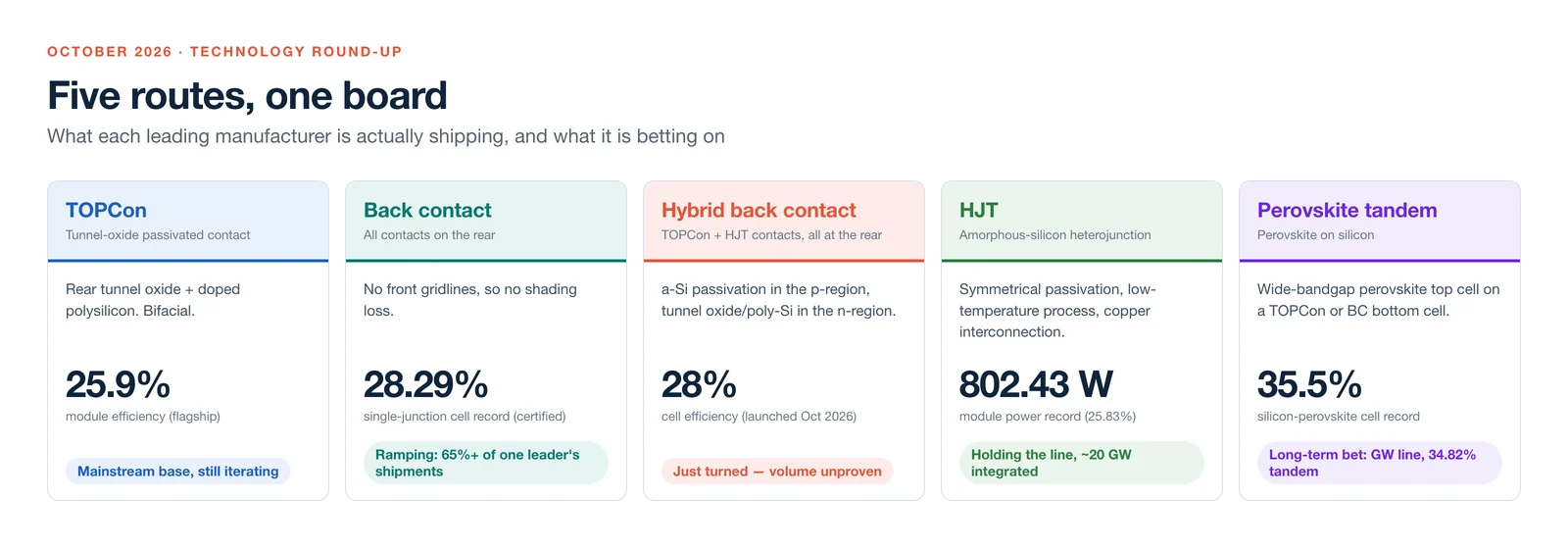
| JinkoSolar (TOPCon volume leader) | Launched the TAC "tank" platform on 17 October: a tunnelling-passivation back-contact cell | 28% cell efficiency; 510 W in a 48-cell Tiger Neo 5.0 format; −0.24%/°C temperature coefficient; up to 40-year warranty |
| LONGi (BC pioneer) | Late September launch in Europe of a hybrid high/low-temperature passivated back-contact cell | 28.29% certified — a single-junction silicon world record; 35.5% silicon-perovskite tandem set in July |
| Tongwei (polysilicon and cell leader) | HJT record plus a dual BC roadmap (p-TBC to n-HTBC); first 5 MW perovskite tandem pilot line built in 2025 | 802.43 W HJT module at 25.83%, twelfth record, using copper interconnection |
| HJT specialist | Showed 760 W-class modules, HJT-perovskite tandem cells and flexible HJT at its September manufacturing conference | ~20 GW vertically integrated capacity |
| Trina Solar (TOPCon volume) | Dual route of "TOPCon 3.0 plus THBC"; first overseas tandem module order signed | Desert field data: 3.05% higher yield per watt than certain BC modules |
| Perovskite supply chain | First GW-scale perovskite line fully connected; a display-panel major confirmed entry; an equipment maker committed ¥3.5 billion to tandem tooling | — |
The Jinko launch is the one that rearranged the chessboard. TAC — tunnelling passivation back contact — puts an amorphous-silicon passivation stack on the p-region (an HJT process) and a tunnel-oxide/poly-silicon stack on the n-region (a TOPCon process), and moves every contact to the rear so the front has no gridlines at all. The company calls it "2+1": two passivation contacts, one back-contact structure.
That is, functionally, a BC cell. Which is the point. The largest TOPCon manufacturer in the world spent two years arguing that BC was a niche premium play, and then shipped a back-contact product. The industry read it as a turn — and a smooth one.
What is confirmed, and what still needs proof
Three categories of claim came out of October, and they carry very different weight.
Confirmed. Efficiency records backed by third-party certification. Product launches announced through official channels. Shipment targets stated on earnings calls. The US injury determination, which appears in a published federal notice and starts the clock on the duty order.
Still to be proven. Mass-production yield and cost for hybrid back-contact architectures — a 28% lab cell and a 28% average production cell are different objects. Perovskite stability: a line being "fully connected" says nothing about how a module behaves in year eight on a rooftop. And the real commercial effect of the tariffs: the duty order has not been formally published, so rates and scope can still move.
The argument is not about efficiency any more
On the surface, the industry is fighting over which route becomes the next mainstream. Underneath, everyone is converging on the same two ideas: a front side with no gridlines, and a better passivation stack. TOPCon's turn, LONGi's all-in BC bet and the HJT camp's insistence all point at the back of the cell.
The differences that remain are commercial, not physical: who ramps first, who gets cost lower, who holds yield stable at scale. Laboratory records are entry tickets. Mass-production cost, field reliability and the premium a customer will actually pay decide who survives the next round. Those battles are fought on production lines, not at launch events.
The US wall: a three-step plug
While Chinese manufacturers traded technology roadmaps, Washington closed another door. On 14 October the US International Trade Commission made a final determination of material injury on crystalline-silicon cells imported from India, Indonesia and Laos — the last step before a duty order is published.
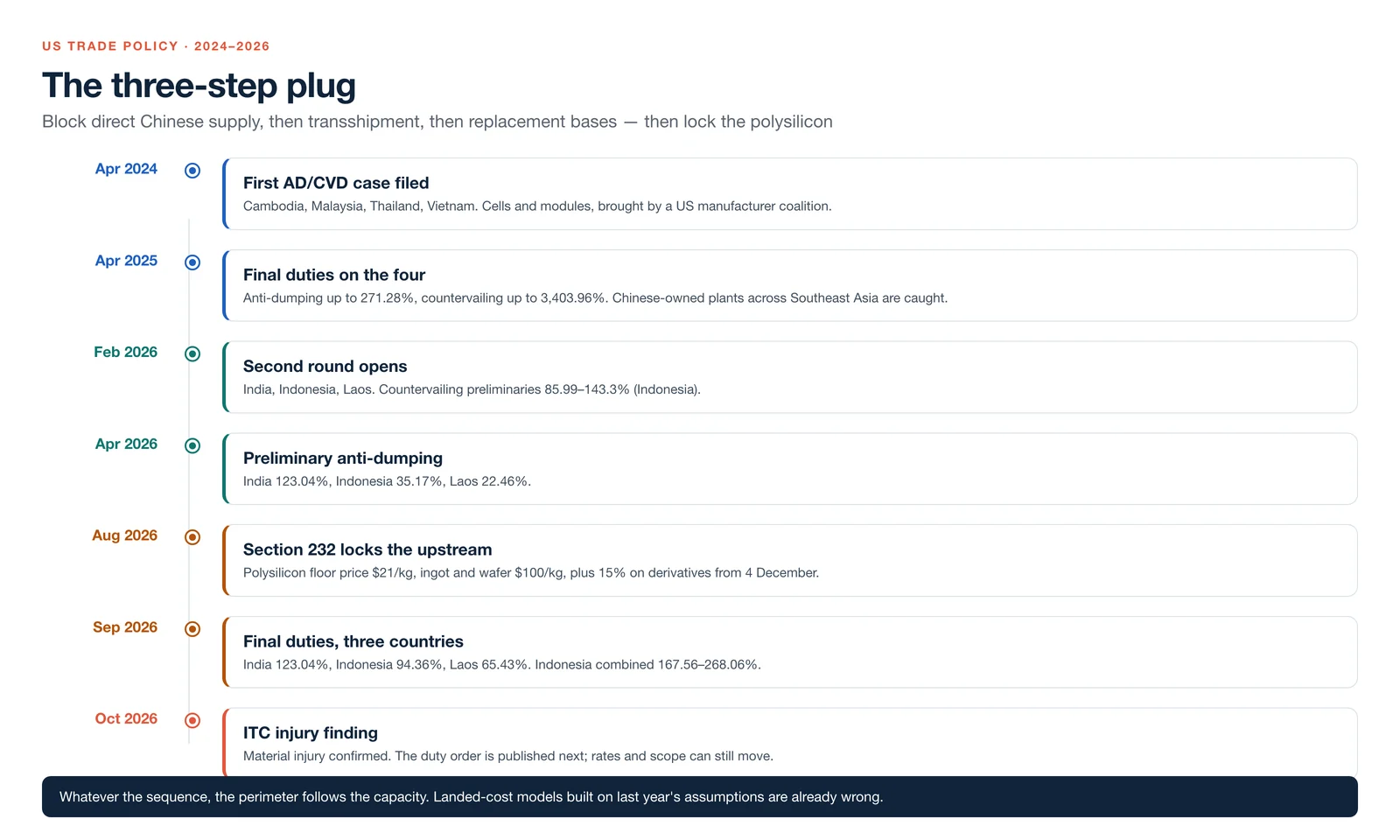
| Date | Action | Scope and rates |
|---|---|---|
| April 2024 | First anti-dumping/countervailing case filed | Cambodia, Malaysia, Thailand, Vietnam |
| April 2025 | Final determinations | Anti-dumping up to 271.28%; countervailing up to 3,403.96% |
| February 2026 | Second AD/CVD round | India, Indonesia, Laos |
| April 2026 | Preliminary anti-dumping margins | India 123.04%, Indonesia 35.17%, Laos 22.46% |
| August 2026 | Section 232 action on upstream material | Polysilicon floor price $21/kg; ingot and wafer $100/kg; additional 15% on derivatives from 4 December |
| September 2026 | Final determinations, three countries | India 123.04%, Indonesia 94.36%, Laos 65.43%; Indonesia combined 167.56–268.06% |
| 14 October 2026 | ITC final injury determination | Duty order publication pending |
The logic is now unmistakable. First, block direct Chinese supply. Then block transshipment through Southeast Asia. Then block the replacement bases. Finally, lock the raw material itself. Wherever capacity relocates, the tariff perimeter follows. This is not aimed at one company; it is a hunt across the whole supply chain.
Who carries the cost
Manufacturers. The value of overseas capacity has to be re-rated. Utilisation rates and margin models for Southeast Asian plants need rebuilding. Building inside the US is close to the only insurance left, at the price of much higher capital expenditure and a longer payback.
Markets. Competition for the Middle East, Latin America and Europe gets sharper. Whoever locks in channel and customers first captures the next cycle of cash flow.
Upstream. If the Section 232 measures take effect on 4 December, polysilicon pricing decouples: the US market becomes a high-price island while the rest of the world reprices around it.
Four things to watch next
- When hybrid back-contact volume actually ramps — and whether yield and cost hold up.
- Whether the BC camp's shipment targets materialise. LONGi has guided to roughly 80 GW of module shipments in 2026 with BC above 65%; that is not a small number.
- HJT's copper-interconnection cost reduction and the timing of its tandem node.
- The 4 December Section 232 effective date and the formal publication of the three-country duty orders — and how the supply chain responds.
What this means for buyers
Three practical consequences for anyone signing purchase orders this quarter:
- Audit the bill of materials, not just the brand. A module assembled in a compliant country can still contain cells or wafers that fall inside a tariff perimeter. Landed-cost models built on last year's assumptions are already wrong.
- Dual-source, and qualify the second source now. Capacity is being redirected toward the Middle East, Latin America and Europe; lead times will move before prices do.
- Check the warranty counterparty. A 30-year performance warranty is only worth the balance sheet behind it. As tariff walls reshape margins, that question deserves a direct answer in the contract.
The direction of the technology is clear: back contact, better passivation, then tandem. The direction of trade policy is equally clear: higher walls, moving targets. Planning for both at once is now the baseline requirement, not a sophisticated one.
If you need current pricing, availability or a landed-cost comparison for a project, talk to the ZOEAST PV team — we ship from multiple manufacturing bases and can model tariff exposure alongside the technical specification.
Figures: ZOEAST PV, redrawn in English from the original technical article.