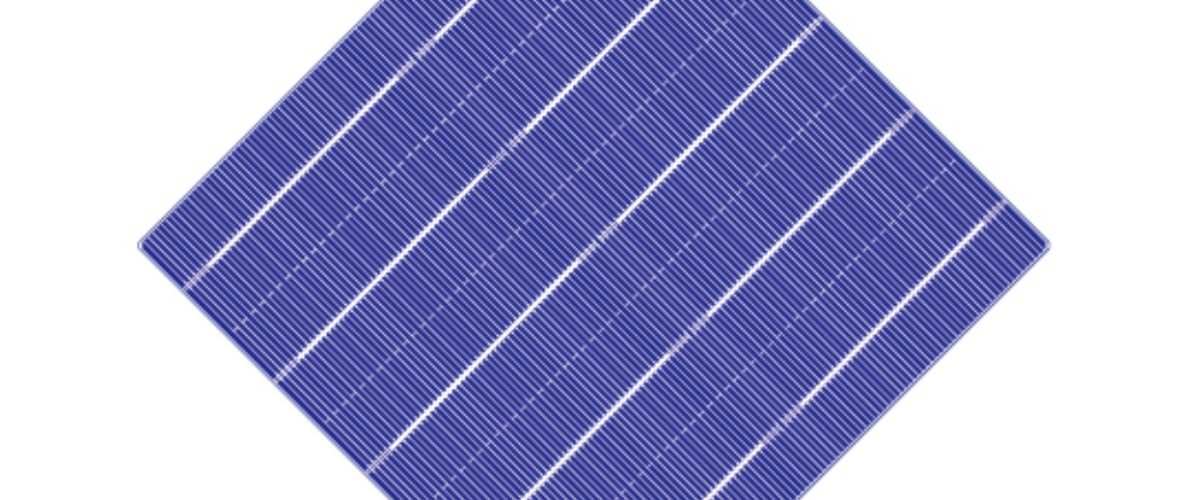
Walk into any module supplier's catalogue and you will find hundreds of SKUs: 450 W, 580 W, 700 W; black, blue, transparent; glass-backsheet, glass-glass, frameless. Most of the differences come down to four classification axes. Once you can place a product on all four, the specification conversation gets much shorter — and much less expensive when you get it wrong.
This guide walks through the four axes in the order that matters for procurement: cell material and crystal structure, cell technology, packaging and generation mode, and end application.
1. By cell material and crystal structure
This is the classic way the industry sorts modules, and it is still the first question a supplier will ask.
Monocrystalline silicon
Sliced from a single-crystal silicon ingot, mono cells have a regular atomic lattice. That regularity shows up as efficiency above 20%, a better temperature coefficient, and a uniform deep-black appearance (older p-type mono wafers had rounded corners). Mono is now the mainstream choice for residential and commercial rooftop systems, at a slightly higher cost per watt than the alternatives.
Multicrystalline silicon
Sliced from a multicrystalline ingot, poly cells show the characteristic blue "ice-flower" pattern and square corners. Efficiency sits around 15–17% and cost is low. Poly modules once dominated on price-performance, but they have essentially exited the mainstream market as mono costs converged.
Thin film
Non-silicon absorbers — cadmium telluride (CdTe), copper indium gallium selenide (CIGS) — or amorphous silicon. Thin-film modules are flexible and lightweight and perform comparatively well in diffuse light, but efficiency is low at roughly 6–15%. They make sense for building-integrated PV (BIPV) and portable or specialty products where weight and form matter more than watts per square metre.
Emerging technologies
Perovskite and perovskite-silicon tandem cells (laboratory efficiencies already above 30%, now entering industrialisation), plus organic photovoltaics (OPV) with flexible, low-cost form factors. These are worth tracking, but they are not yet a volume procurement category.
2. By cell technology: p-type versus n-type
The second axis is the one that has changed most in the last five years. It is about the doping and passivation architecture of the cell, not the wafer format.
| Family | Representative technology | What it is good at | Where it fits |
|---|---|---|---|
| p-type | PERC (passivated emitter and rear cell) | Low cost, mature supply chain, proven bankability | Price-sensitive projects; legacy capacity |
| n-type | TOPCon (tunnel oxide passivated contact) | Better efficiency, lower degradation and better temperature coefficient than PERC; the most mature n-type route | Default choice for utility and C&I projects |
| n-type | HJT (heterojunction) | High open-circuit voltage, very low initial degradation, excellent bifacial performance | Projects that value long-term stability; capex-heavy to produce |
| n-type | BC (back contact) | No front gridlines, so no shading loss and a higher efficiency ceiling; clean all-black look | Premium residential roofs and high-value niches |
If you are specifying a new plant today, n-type is the baseline, not an upgrade. PERC remains available and inexpensive, but the market has moved.
3. By packaging and generation mode
Single-glass versus double-glass
A single-glass module uses front glass plus a polymer backsheet. It is lighter and cheaper, and remains the standard for residential rooftops. A double-glass module sandwiches the cells between two sheets of glass: heavier, but far more resistant to damp heat, UV and potential-induced degradation (PID), which is why it is preferred for coastal sites, floating PV and installations with high humidity or high system voltage.
Monofacial versus bifacial
A monofacial module collects light on the front only. A bifacial module also collects reflected light on the rear, adding a gain that typically falls in the 5–30% range depending on albedo, mounting height and tilt. Bifacial is now standard for utility-scale ground mounts and increasingly common in carports and elevated commercial rooftops; the economics depend entirely on site reflectivity and mounting geometry.
4. By application
The fourth axis is where most specification mistakes happen, because it cuts across the first three.
- Residential rooftops — high-efficiency n-type mono or BC modules; appearance and weight matter, and area is limited.
- Commercial and industrial rooftops — n-type TOPCon in 550–600 W+ formats; balance of efficiency, weight and price, often with bifacial glass-glass construction where wind and humidity are aggressive.
- Utility-scale ground mounts — the lowest cost per kWh at scale: TOPCon bifacial modules in large formats, mounted on trackers.
- BIPV — flexible thin film or BC modules in custom colours and sizes, where the module is a building component and aesthetics are part of the specification.
- Portable and off-grid — small-format thin film or folded mono modules, where power density per kilogram dominates.

A quick selection matrix
| Scenario | Typical choice | Why |
|---|---|---|
| Dry, mild-climate residential roof | n-type TOPCon or BC, single-glass | Best watts per square metre at reasonable cost |
| Coastal or high-humidity commercial roof | n-type TOPCon/BC, glass-glass, POE or EPE encapsulant | Moisture and PID resistance over 25+ years |
| Utility-scale tracker field | TOPCon bifacial, large format, glass-glass | Lowest LCOE; rear-side gain adds yield |
| Building façade / visible architecture | BC or custom-colour modules, BIPV frames | Uniform appearance, no front gridlines, custom dimensions |
| Water surface or floating array | Glass-glass, high-PID-resistance encapsulant | Constant humidity and high voltage stress |
What the current market actually looks like
Across these categories, the market has converged on one answer: n-type monocrystalline silicon. Multicrystalline has been retired from mainstream supply, thin film survives in BIPV and specialty niches, and emerging technologies such as perovskite tandem are still scaling. For a buyer signing a 2026 supply contract, the real decision is not mono versus poly — it is which n-type architecture, and which packaging, fits the site.
That decision has a direct commercial consequence: two modules with the same nameplate wattage can differ by several percent in annual yield, by a decade in expected service life, and by a large multiple in warranty claims. The classification axes above are the cheapest way to keep those differences visible during negotiation.
Next step
If you are comparing module options for a specific project, our engineering team can run the numbers on cell technology, packaging and mounting for your site conditions. Browse the ZOEAST PV module range or send us your project parameters.