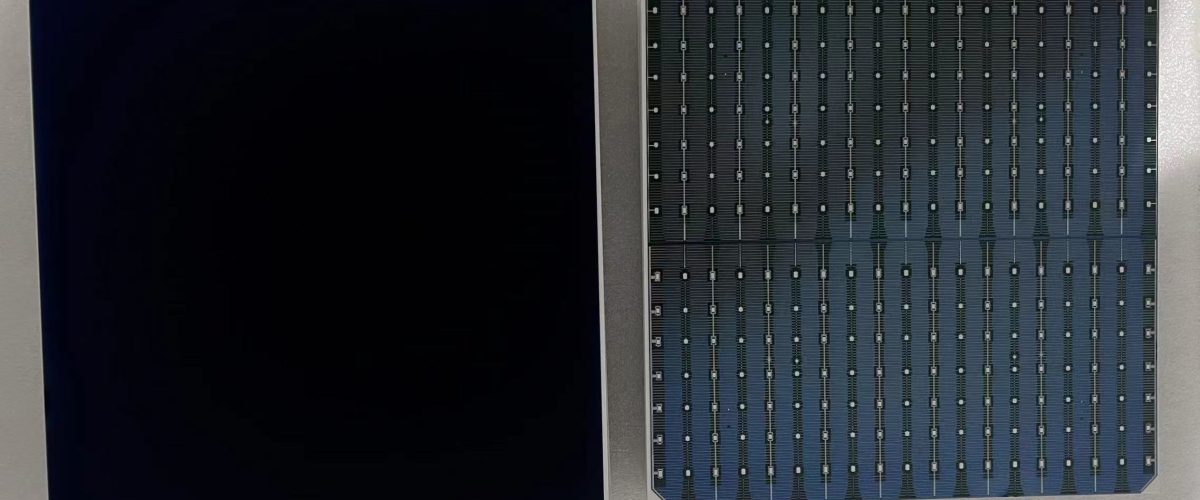
Solar manufacturing stopped being a capacity race a while ago. Anybody can buy a line; the differentiation now sits in cell architecture, process control and how well the module holds its power in year fifteen. That shift is why every purchase conversation in 2026 starts with the same word: n-type.
Why n-type took over
Compared with the p-type PERC cells that dominated the last decade, n-type wafers offer lower degradation, a better temperature coefficient and more stable output in low-light conditions. The practical translation: a new plant specified today is almost always n-type, and a p-type quote is usually a sign that somebody is clearing inventory.
Within n-type there are three architectures in commercial production — TOPCon, HJT and BC — plus a fourth, tandem, that everybody is aiming at.
The three routes at a glance
| TOPCon | HJT | BC (back contact) | |
|---|---|---|---|
| Structure | Tunnel-oxide passivated contact on the rear | Amorphous-silicon heterojunction with transparent conductive oxide | Both contacts moved to the rear; no front gridlines |
| Strengths | Most mature at volume; stable yield; controllable cost; largest shipments and the most complete supply chain | High open-circuit voltage; very low initial degradation; excellent temperature behaviour | More active area on the front, higher efficiency ceiling, better-looking all-black surface |
| Constraints | Efficiency ceiling below BC; rear-side process window | Highest capex per GW; low-temperature metallisation and interconnection required | Patterning and alignment complexity; higher cost per GW; tighter process control |
| Typical use | Utility-scale, C&I, most of the market | Projects that value long-term stability; premium products | Premium residential rooftops, BIPV, high-value niches |
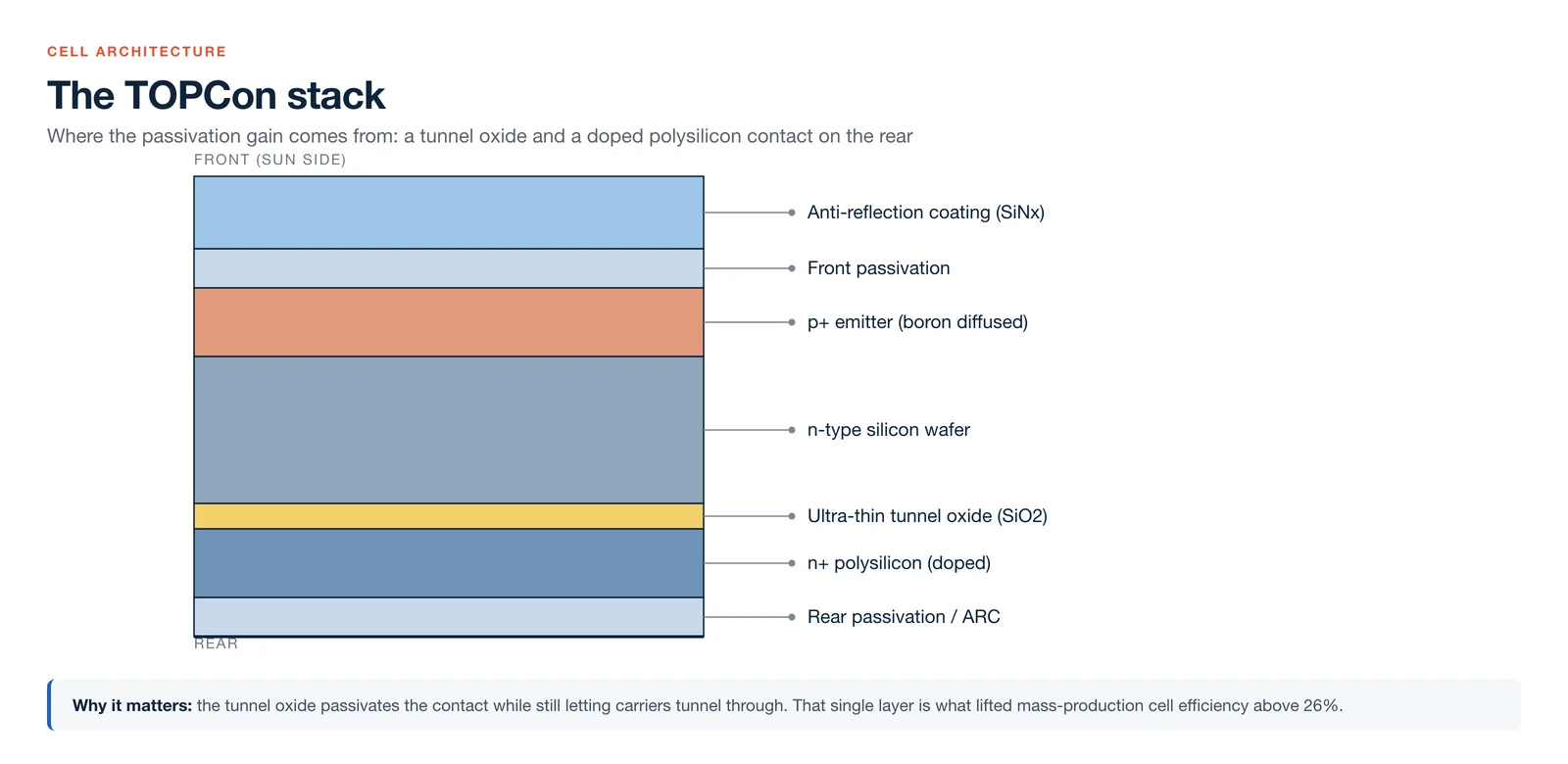
TOPCon
Tunnel-oxide passivated contact is the route that scaled. Yield is under control, cost is under control, and the entire chain — LPCVD and PECVD equipment, paste, ribbon, encapsulant — is built around it. That is why the largest shipment volumes are TOPCon and why it will remain the default for utility and commercial projects for years.
HJT
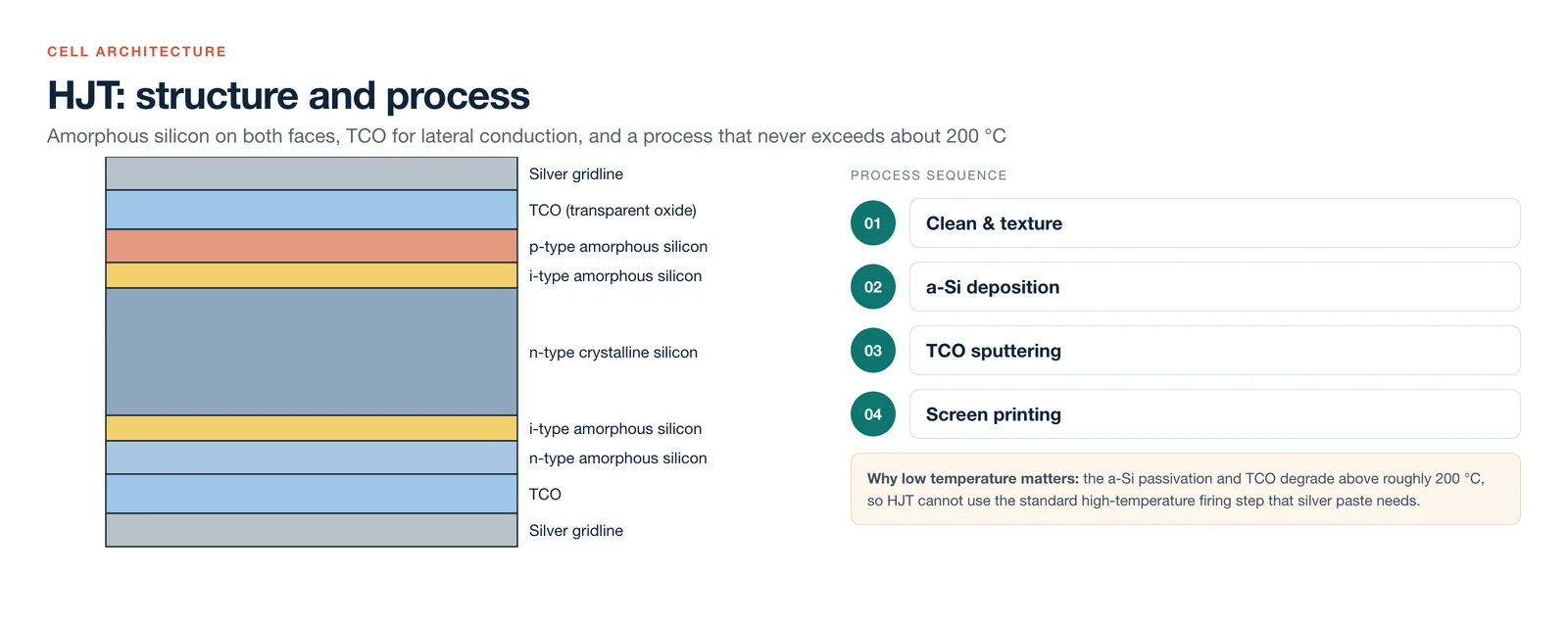
Heterojunction cells deliver high open-circuit voltage and a very small initial degradation, which makes them attractive where long-term stability matters more than capital cost. The constraint is the line itself: HJT needs low-temperature processes and low-temperature interconnection, and the equipment bill per gigawatt is higher. That is why HJT has stayed a smaller share of capacity despite excellent cell physics.
BC
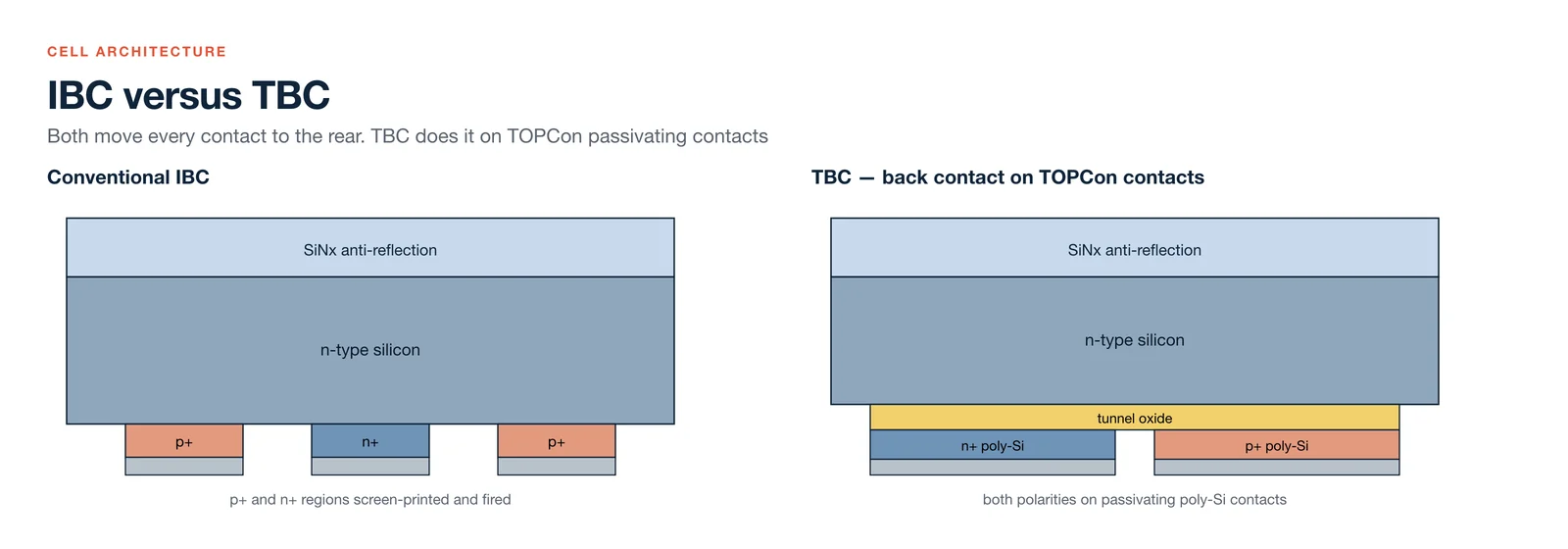
Back-contact cells move the emitter and the base contacts to the rear, so nothing shades the front. More active area means a higher efficiency ceiling and a cleaner appearance, which is why leading manufacturers are pushing BC hard in premium residential and architectural products. The trade-off is complexity: patterning, alignment and yield control all get harder, and cost per gigawatt is higher than TOPCon.
Tandem and perovskite
Perovskite-silicon tandem is the long-term direction — record efficiencies above 35% have already been certified. It is still in the ramp-up phase: stability, large-area yield and cost are not yet where the silicon industry needs them to be. Nobody credible expects tandem to replace crystalline silicon quickly; the more likely path is that tandem uses silicon as its bottom cell and inherits the existing supply chain.
How a module gets built — and where defects come from
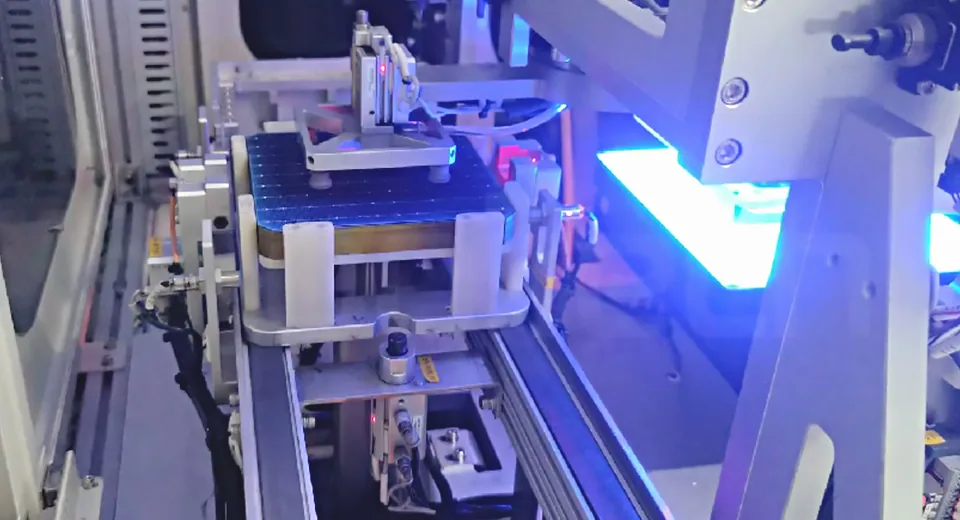
Every architecture runs the same chain: polysilicon is pulled into ingots, sliced into wafers, processed into cells, then stringed, laminated, framed and tested. Each step leaves fingerprints on the final module.
At the cell and module level, three inspections do most of the quality work: IV testing for power and electrical behaviour, EL imaging for hidden defects, and AOI for surface and print defects. EL is where the expensive problems show up — microcracks, cold solder joints, broken fingers, black spots and shunting.
The connection to field performance is direct. Modules that lose power quickly in service, or develop hot spots and open circuits after a few years, very often trace back to manufacturing control: a soldering recipe that ran too hot, a lamination window that was missed, a wafer that was cracked at handling. Plant-level process discipline is not an abstraction — it is the difference between a 30-year asset and a warranty claim.
What buyers should actually compare
Nameplate wattage is the least interesting number on a datasheet. Compare these instead:
- First-year and annual degradation, in the written warranty, not the brochure. Typical n-type products offer around 1% first-year and 0.4%/year thereafter — read the exact clauses.
- Temperature coefficient (Pmax). A better coefficient is worth real energy in hot climates.
- Bifaciality factor, if the site can use rear-side gain.
- EL images at factory acceptance, on a sample basis, with the test standard and pass criteria agreed in the contract.
- Certification scope: IEC 61215 and IEC 61730 for the exact bill of materials being shipped, not for a similar product.
- PID and LID/LeTID test data at module level.
The direction of travel
Competing on price alone is a losing strategy, and the industry knows it. The next cycle is about conversion efficiency, degradation, reliability and intelligent O&M — plus the system-level opportunities: solar-plus-storage, building-integrated PV, and integration with energy dispatch.
For a buyer, that means the technology choice matters less than the execution behind it. A well-made TOPCon module from a disciplined factory will outperform a badly made BC module every year of its life. Architecture sets the ceiling; process control decides where you land.
If you are weighing TOPCon, HJT or BC for a specific project, send us the site parameters and we will model the annual yield difference rather than the datasheet difference. You can also read our deeper comparison of TOPCon and BC market dynamics and how TOPCon works.
Diagrams redrawn in English from the original article; inspection photo from the same source.