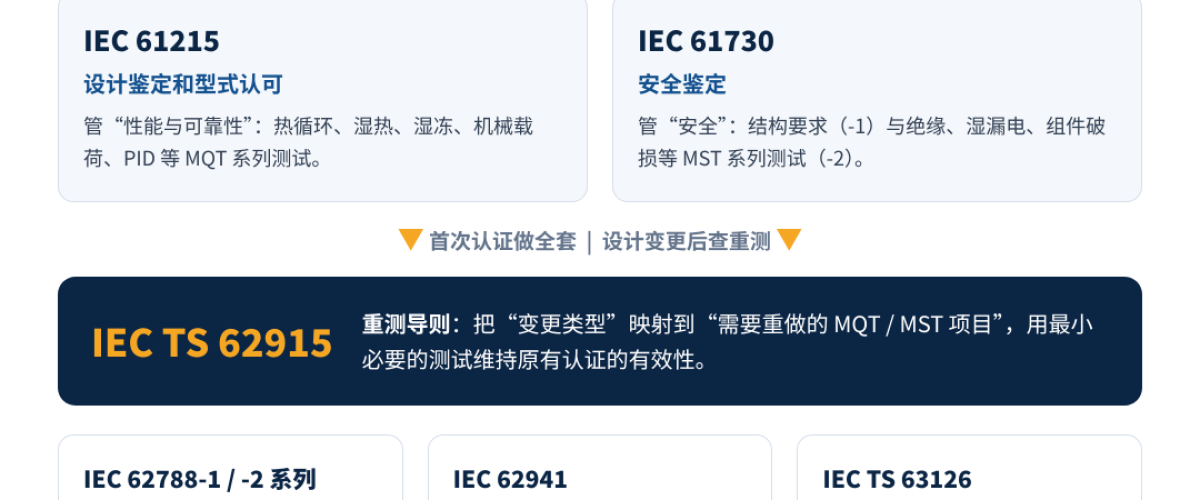
A module that holds IEC 61215 and IEC 61730 certificates is a qualified product. Then purchasing finds an encapsulant that is two cents cheaper, process engineering proposes thinner glass, R&D wants the next cell format, and sales asks for a 1500 V version. Each sounds like a small change. The question nobody wants to answer is whether the certificate still covers the module you are shipping.
IEC TS 62915 exists to answer exactly that: given what changed, which tests have to be repeated? It is not a new test standard, and it is not a free pass. It is the mapping between a change and the retest work that keeps a type approval valid.
Why a retest guide had to exist
A full qualification is expensive and slow. One round of IEC 61215 and IEC 61730 needs several samples and runs thermal cycling, damp heat, humidity freeze, UV, mechanical load and more — months of calendar time. But solar is a business of relentless cost reduction, so a bill of materials never stays still.
That leaves two bad options. Re-qualify for every change and the whole industry slows down. Test nothing and the certificate describes a product that no longer matches what leaves the factory. Before 2018, the same change could produce different test plans at different labs. IEC fixed the rules as a Technical Specification, and the value is right there in its scope: a uniform way to maintain type approval, design and safety qualification for modules that have changed or are about to.
What the document actually is
| Standard | IEC TS 62915 |
| Title | Photovoltaic (PV) modules — Type approval, design and safety qualification — Retesting |
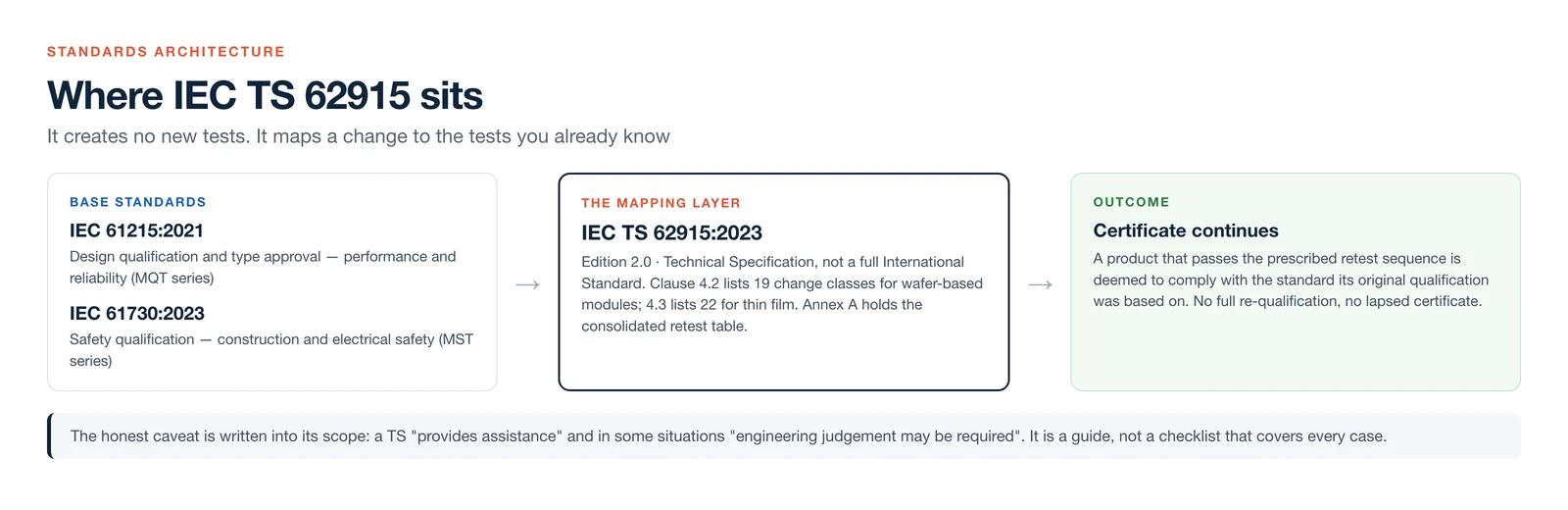
| Document type | Technical Specification (TS), not a full International Standard |
| Committee | IEC TC 82, solar photovoltaic energy systems |
| Current edition | Ed. 2.0, September 2023, replacing the 2018 first edition |
| Corrigendum | COR1, August 2024 |
| Applies to | Wafer-based (crystalline) modules, WBT; monolithically integrated thin film, MLI |
Two points matter. First, 62915 creates no new test methods: every test item, sample count and pass criterion comes from IEC 61215 and IEC 61730. Second, its legal effect is explicit — a product that passes the prescribed sequence is deemed to comply with the standard its original qualification was based on. The certificate continues.
It is also honest about its limits. As a TS it "provides assistance", and it says outright that engineering judgement may be required in some situations. It is a guide, not an exhaustive checklist.
How the document is organised
- Clause 4.1 — general rules that apply to every retest (below).
- Clause 4.2 — test plans for wafer-based modules, split into 19 change classes.
- Clause 4.3 — thin-film modules, 22 classes; content already covered in 4.2 is not repeated, so only thin-film specifics such as TCO front contact, rear contact and edge deletion appear.
- Annex A — Table A.1 (the consolidated retest table), Figure A.1 (the joint 61215/61730 flow) and A.3 (assessment of new material and component combinations).
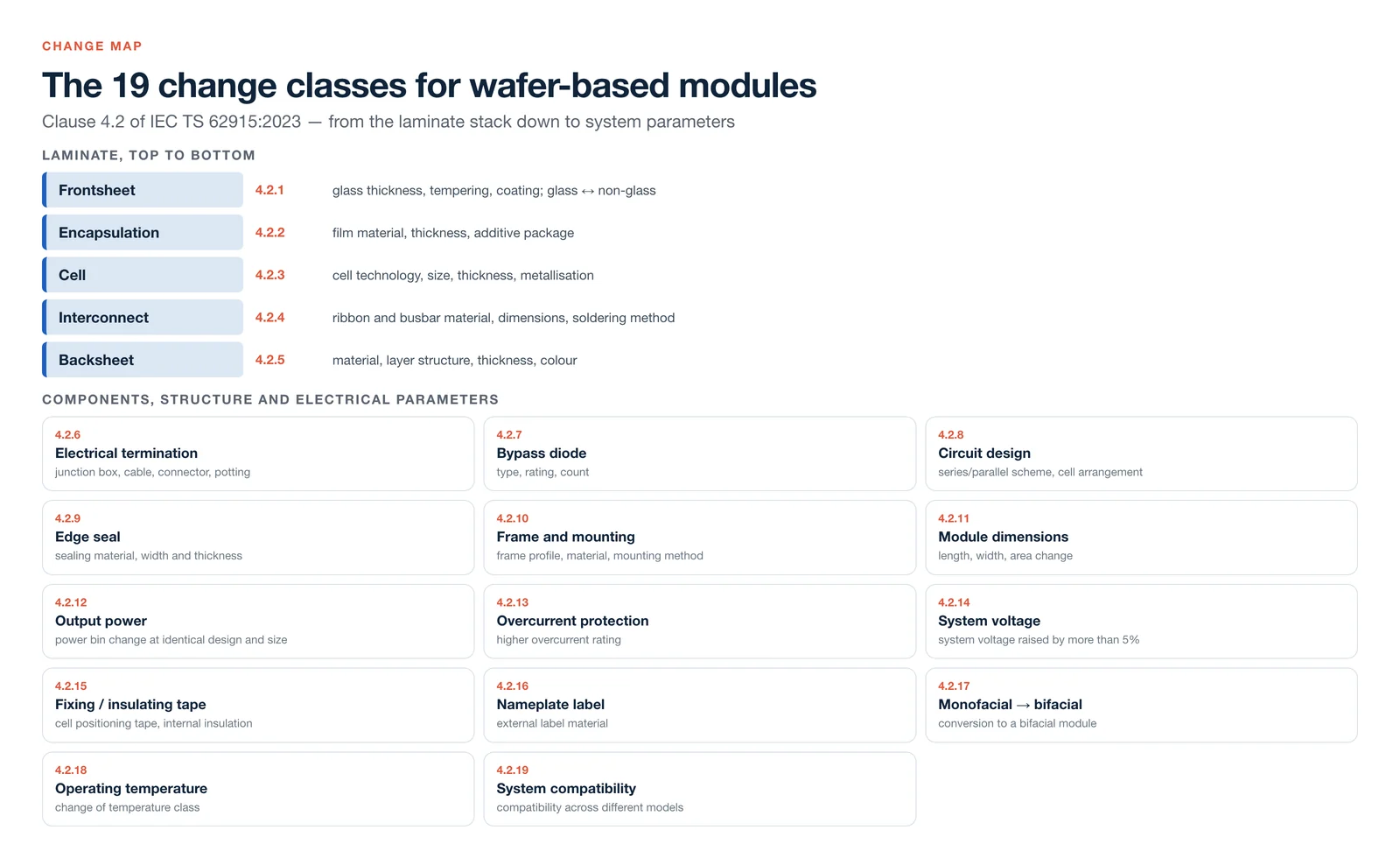
Each sub-clause follows the same shape: first which situations count as a change, then which IEC 61215 (MQT) and IEC 61730 (MST) items must be repeated. Edition 2 lists the two separately, which makes life easier whether you are doing one qualification or both together.
The MQT and MST codes you will keep meeting
MQT items come from IEC 61215-2; MST items from IEC 61730-2. The most frequently cited:
| Code | Test | Code | Test |
|---|---|---|---|
| MQT 01 | Visual inspection | MQT 13 | Damp heat |
| MQT 03 | Insulation test | MQT 15 | Wet leakage current |
| MQT 06.1 | Performance at STC | MQT 16 | Static mechanical load |
| MQT 09 | Hot-spot endurance | MQT 17 | Hail |
| MQT 10 | UV preconditioning | MQT 19 | Stabilisation |
| MQT 11 | Thermal cycling | MQT 20 | Dynamic mechanical load |
| MQT 12 | Humidity freeze | MQT 21 | Potential-induced degradation |
On the safety side, the usual suspects are MST 01 (visual), MST 03 (maximum power), MST 16 (insulation), MST 17 (wet leakage), MST 32 (module breakage) and MST 53 (damp heat).
The six general rules that decide how you use the tables
| Rule | What it means in practice |
|---|---|
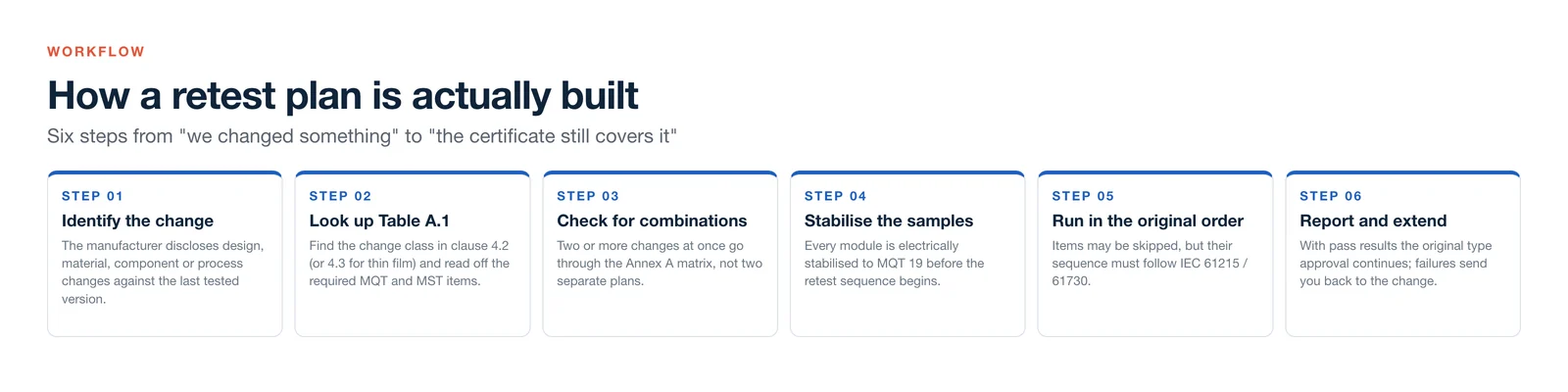
| Disclosure is the manufacturer's duty | You must declare design, material, component, material-combination, manufacturer and process changes against the last tested version — and supply component-level data if you want it credited. |
| “Different material” has a definition | Different chemical composition, type designation or specification — including electrical, optical and mechanical properties and their tolerances. A new supplier or production site is not automatically a different material if it can be clearly demonstrated. |
| The baseline is the first tested value | New thickness or dimensions are judged against the originally tested value. If your declared tolerance exceeds the trigger (the standard's example is a 10% reduction in front glass thickness), the component must be tested at the worst-case limit. |
| Stabilise first | Every retest module is electrically stabilised to MQT 19 before the sequence, with initial and final measurements per the applicable standard. |
| Order is preserved, items are not | If only some items of a sequence are repeated, they still run in the order the base standard prescribes. You may skip; you may not reorder. |
| Combinations go through Annex A | Two or more simultaneous changes are assessed with the A.3 matrix, not with two separate plans. |
Where the triggers actually bite
- Glass frontsheet replaced by a non-glass frontsheet (or the reverse) is not a retest at all — the frontsheet type change means full qualification. It is a new product.
- Glass thinning: the general clause's own example is a 10% reduction in front glass thickness, which triggers retesting. With the industry moving from 3.2 mm to 2.0 mm, this is the most frequently encountered rule of the decade.
- Cell size: clarified through the 2024 corrigendum discussions — a change of more than 10% in cell length, width or area triggers retesting; below 10%, no retest is needed provided cell spacing and cell-to-busbar spacing stay the same or increase.
- System voltage: clause 4.2.14 sets the threshold in its title — an increase of more than 5%. Moving from 1000 V to 1500 V is squarely inside it.
- Same design, different power bin: clause 4.2.12 handles a higher or lower output at identical design and dimensions — a routine situation when extending a power range.
- Monofacial to bifacial: Edition 2 added a dedicated clause, 4.2.17.
These are examples for intuition, not a substitute for the standard: each class has further sub-cases and exceptions, and the actual plan is set with the standard text, Table A.1 and the certification body's assessment.
What Edition 2 changed
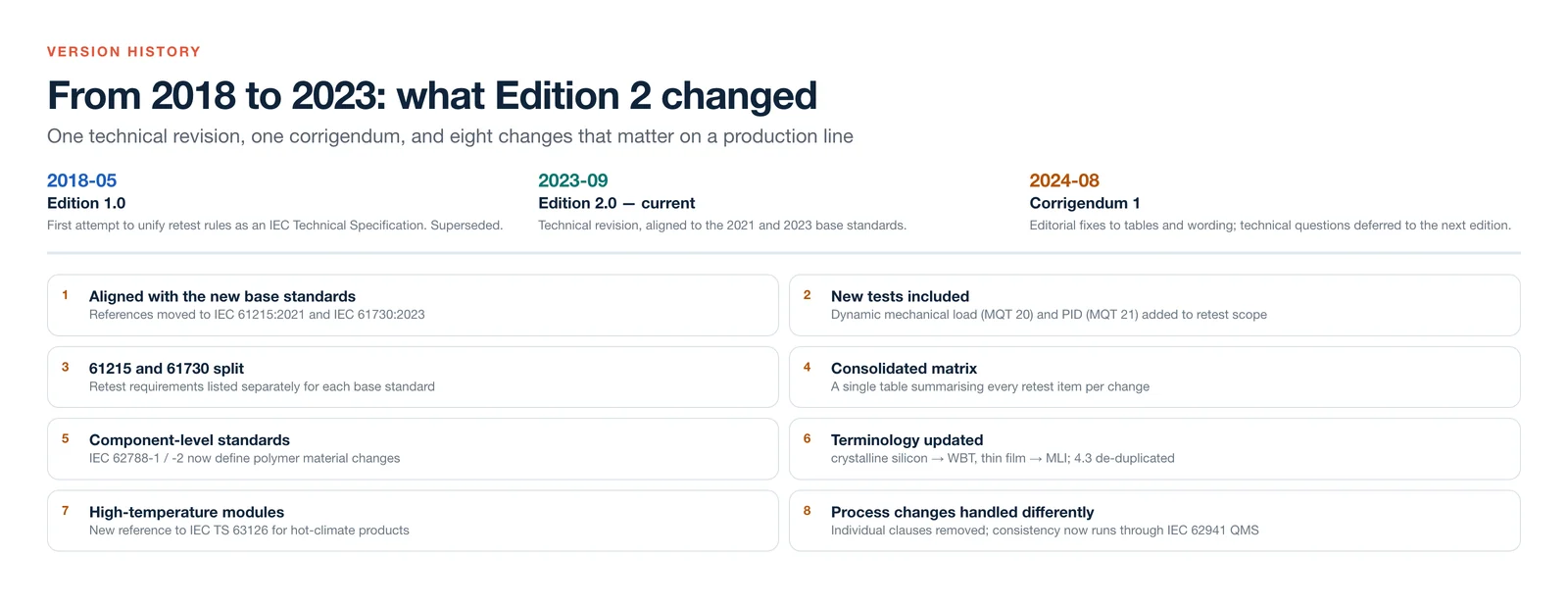
Three of the eight changes matter most day to day. References moved to IEC 61215:2021 and IEC 61730:2023, which brought dynamic mechanical load (MQT 20) and PID (MQT 21) into the retest scope. Clauses addressing specific process changes were deleted, replaced by a general requirement to maintain a consistent quality management system per IEC 62941 — process changes are now a QMS question. And IEC 62788-1 / -2 were introduced so that polymer material changes (encapsulant, frontsheet, backsheet) are defined by component-level standards.
COR1 (August 2024) is editorial, fixing inconsistencies between tables and text. The document's stability date is 2026, when it will be confirmed, withdrawn or revised; the working group has signalled that technical questions are deferred to the next edition.
Five things engineers should take away
- Put the retest assessment into design review. When a new material or cost-down project is proposed, estimate the retest scope from Table A.1 then, not after samples are built.
- Merge changes into one submission. Group simultaneous changes into a single retest round and use the A.3 matrix to avoid duplicate sequences.
- Choose tolerances with the future in mind. Because the baseline is the first tested value, the thickness, dimensions and tolerances you certify with dictate how much room you have to change later.
- Manage the material "identity card". A supplier reformulating without changing the type designation is the hardest and most dangerous change to catch; incoming inspection and supplier change-notification are the only defence.
- Passing a retest is not a field guarantee. 61215 and 61730 are qualification tests for design defects, not lifetime predictions — and 62915 only carries that same level of assurance forward.
How ZOEAST PV applies it
ZOEAST PV runs a change-control process around this document. Any proposed bill-of-materials change — encapsulant, glass, frame, junction box, ribbon — is first mapped against clause 4.2 to see whether it is a retest class, a full re-qualification, or a documented "no change" under the material definition. Supplier change notifications are treated as change requests rather than paperwork.
Practically, that means we can tell a customer which certificate covers the exact BOM they are buying, and what a proposed substitution would do to it. For projects where the module specification is still open, we would rather discuss the tolerance window up front than discover a retest obligation after the order.
If you need the certification scope for a specific configuration, send us the bill of materials and we will confirm the applicable certificates; the product range is on the module page.
Sources: IEC TS 62915:2023 (Edition 2.0) and COR1:2024; IEC 61215-1/-2:2021; IEC 61730-1/-2:2023; IEC 62788-1/-2; IEC 62941. Clause numbers, thresholds and examples are quoted from the standard as summarised in the original article; for any actual retest plan, consult the standard text, Table A.1 and your certification body. Figures: ZOEAST PV, redrawn in English from the original technical article.