Silver is the most expensive material in a solar cell that is not doing any optical work. It is there to conduct, and it is very good at it — but the price is set by electronics and jewellery demand, not by the solar industry's cost curve. Metallisation is now one of the few remaining line items where a meaningful cost reduction is still available.
Copper has always been the obvious substitute. It is cheap and it conducts well. The problem is that copper diffuses through silicon quickly, and a copper atom sitting in the wrong place becomes a deep-level recombination centre — which costs you minority-carrier lifetime, open-circuit voltage and long-term reliability.
A September 2026 result from Georgia Tech, working with Bert Thin Films and US Department of Energy national laboratories, shows how far that problem has been pushed. Using screen-printed copper paste on the rear of an n-type TOPCon cell plus a laser contact treatment, the team reached 24.33% best efficiency, with an independently measured 24.4%.
What the numbers actually show
| Metric | Copper rear contact | All-silver reference | Comment |
|---|---|---|---|
| Best efficiency | 24.33% | 24.54% | About 0.21 percentage points lower |
| Average efficiency | 24.14% | 24.32% | About 0.18 points lower |
| Independently measured | 24.4% | 24.6% | Close to the silver reference |
| Open-circuit voltage | >730 mV | >730 mV | Copper contact did not measurably pull Voc down |
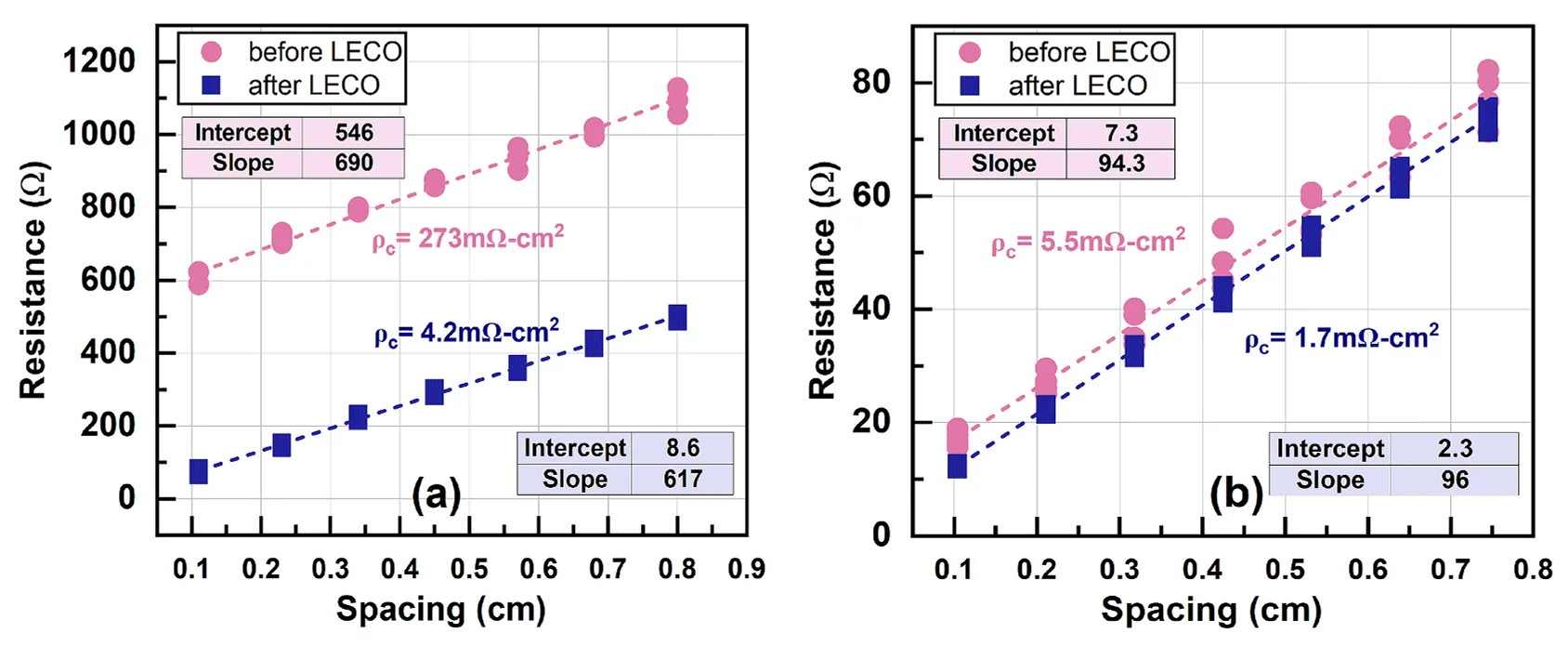
| Rear contact resistivity | 19.7 mΩ·cm² after LECO | Not reported | Above 100 mΩ·cm² before LECO |
| Metal-induced recombination (J0,metal) | ~14 fA/cm² | Roughly 4× higher | Copper contact recombines less |
| Rear copper coverage | 18% | Not reported | Increased grid count to cut series resistance |
The headline is not "TOPCon is now silver-free" — it is not. The headline is that replacing the rear silver electrode with copper cost about 0.2 percentage points, which is small enough to be recovered elsewhere in the bill of materials.
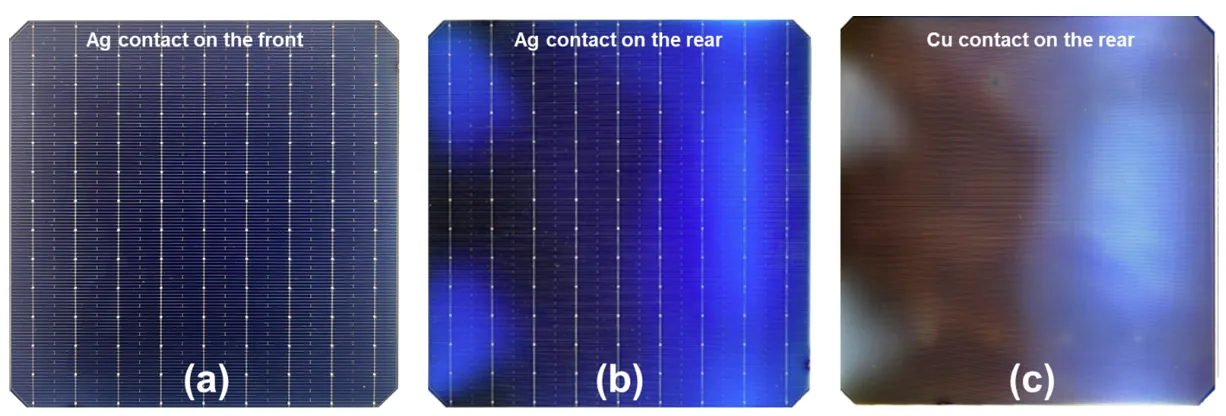
The hard part is not printing
Substituting copper for silver is an old idea. What has changed is the control of two failure mechanisms.
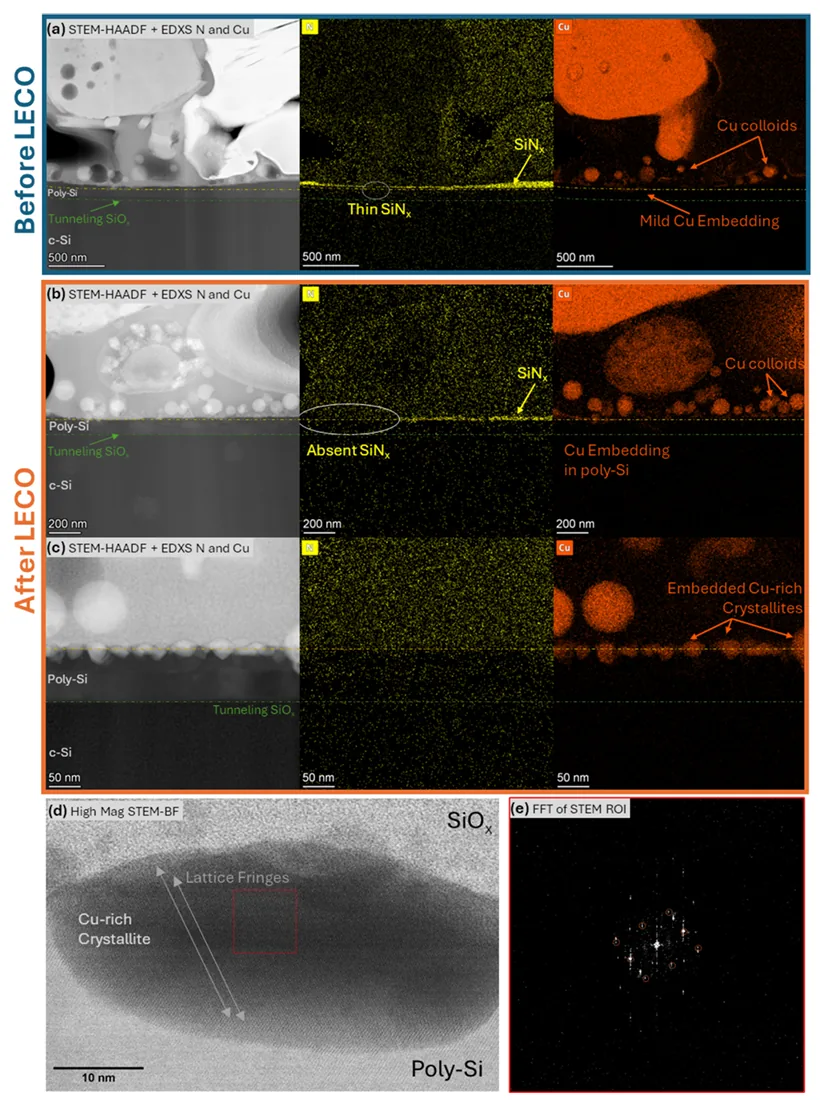
Diffusion. Copper that crosses the tunnel oxide and the poly-silicon layer into the silicon bulk creates recombination centres. The Georgia Tech work uses two defences. First, the sintering temperature is held at about 540 °C, well below the peak of a conventional silver firing step. Second, the copper paste itself is designed so that a copper-rich oxide structure forms around the copper particles during sintering, acting as a diffusion limiter.
Microscopy supports the mechanism: after LECO processing, copper-rich grains remain inside the rear poly-silicon layer, with no significant deep diffusion into the silicon bulk observed. The measured metal-induced recombination of about 14 fA/cm² — roughly a quarter of the silver reference — is consistent with that, and explains why Voc stayed above 730 mV.
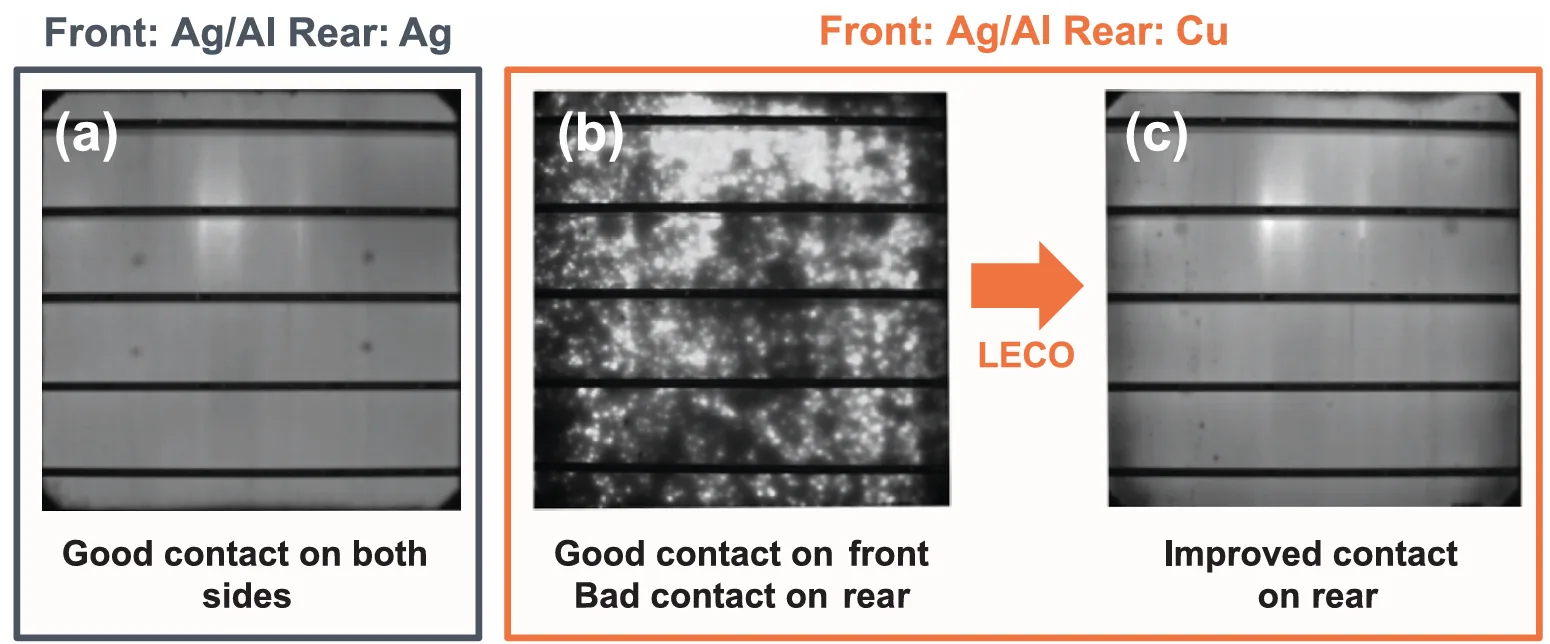
Contact. Low-temperature sintering protects the silicon, but it also leaves the metal-semiconductor contact incomplete, and contact resistance climbs. In the as-printed state, the copper contact exceeded 100 mΩ·cm², which would destroy fill factor.
LECO fills the gap
LECO — laser enhanced contact optimisation — solves that. A reverse bias is applied across the cell while a laser scans it rapidly; the local current concentration improves regions where contact was poor. In this work it brought rear contact resistance down to 19.7 mΩ·cm². To push series resistance lower still, the team increased rear copper coverage from about 7% to 18%, adding gridlines to compensate for copper's higher contact resistance relative to silver.
Put together, the process is a sequence: print copper paste, sinter at roughly 540 °C, control copper diffusion through paste chemistry, then apply LECO to repair the contact. That is a much smaller change to a factory than building a plating line.
Precisely what was built
The device is still a hybrid: silver on the front, copper on the rear. Starting from a commercial n-type TOPCon precursor, the front carries a boron-diffused emitter with AlOx/SiNx passivation; the rear has a tunnel oxide and roughly 90 nm of n-type poly-silicon.
Calling this a "silver-free TOPCon cell" would be inaccurate. The correct description is a 24.3%-class TOPCon cell with a copper rear electrode and substantially reduced silver consumption. The team's stated next objective is to combine copper with aluminium and reach a genuinely silver-free device — which would mean the front metallisation also has to change.
It is also worth noting that this is not the group's first result above 24% with screen-printed copper contacts; earlier 2026 work had already crossed that line. The September paper focuses on contact resistance, metal-induced recombination, microstructure and the loss mechanisms behind the numbers.
Why the industry cares: the line does not have to change
Bert Thin Films launched its CuBert copper paste in February 2026 with a specific pitch: it runs on conventional screen printers, screens and belt furnaces, and fires in air, with no plating line required. The company reports 25-kilogram batch scale-up and fine fingers down to about 20 µm.
That is a different industrialisation path from copper plating. Plating offers lower resistance and finer fingers, but requires wet-processing equipment, chemical handling and line modification. Screen-printed copper paste is attractive precisely because it preserves the existing TOPCon line. If the contact resistance, diffusion and reliability issues can be solved on large-format cells, the retrofit barrier for existing TOPCon manufacturers is far lower than building plating capacity.
What still stands in the way
- Contact resistance. 19.7 mΩ·cm² is a big improvement, but there is still headroom before copper matches silver.
- Metal usage. The 18% rear coverage that fixes series resistance also increases paste consumption and constrains the grid design.
- Reliability evidence. Thermal stability at the 1,000-hour level and damp heat at the 2,000-hour level are encouraging, but PID, thermal cycling and multi-year outdoor data are still needed.
- Front side. The emitter contact remains silver. A true silver-free cell requires a front metallisation breakthrough, and that is where most of the remaining silver sits.
The takeaway
Silver thrifting is no longer a laboratory curiosity; it is a manufacturing roadmap. For module buyers, the practical questions are the ones that always apply when a bill of materials changes: is the new metallisation inside the certification scope, what does the manufacturer's reliability data actually cover, and does the warranty survive the change?
For manufacturers, the appeal is straightforward. A 0.2-point efficiency penalty against a meaningful reduction in silver cost per watt is a trade many would take — provided the field data holds up for a decade.
Why ZOEAST PV watches metallisation closely
Cells are the largest single cost in a module, and silver is the most volatile line inside that cost. ZOEAST PV buys n-type cells from multiple qualified lines and therefore sees metallisation changes — paste supplier, finger design, LECO availability — before they reach a customer's bill of materials.
Our rule is that no metallisation change ships on a datasheet alone. A new paste or firing recipe is qualified with EL imaging, ribbon pull tests, PID and damp-heat runs on finished laminates, and the change is only released when the module-level data holds, not just the cell-level efficiency. The 1,000-hour thermal and 2,000-hour damp-heat results described above are a starting point, not a bankability case.
If you need a bill-of-materials review or current pricing, talk to our team; specifications for the cells we supply are on the solar cell page.
Sources: ScienceDirect, PV Tech, pv magazine Global, and public materials from Georgia Tech and Bert Thin Films.
Figures: Georgia Tech / Bert Thin Films, reproduced from the source article.