Two numbers frame this debate better than any efficiency chart. TOPCon has more than 800 GW of capacity, over 65% of global cell capacity and more than ¥500 billion of industrial investment behind it. Back-contact (BC) holds roughly 5–11% of cell market share and is still climbing its ramp.
Those are not the numbers of two evenly matched rivals. They are the numbers of a mainstream technology and a premium challenger — which is exactly why the argument is so noisy. What is being contested is not which cell is better. It is who owns the mainstream for the next five to ten years.
Two stories, both too simple
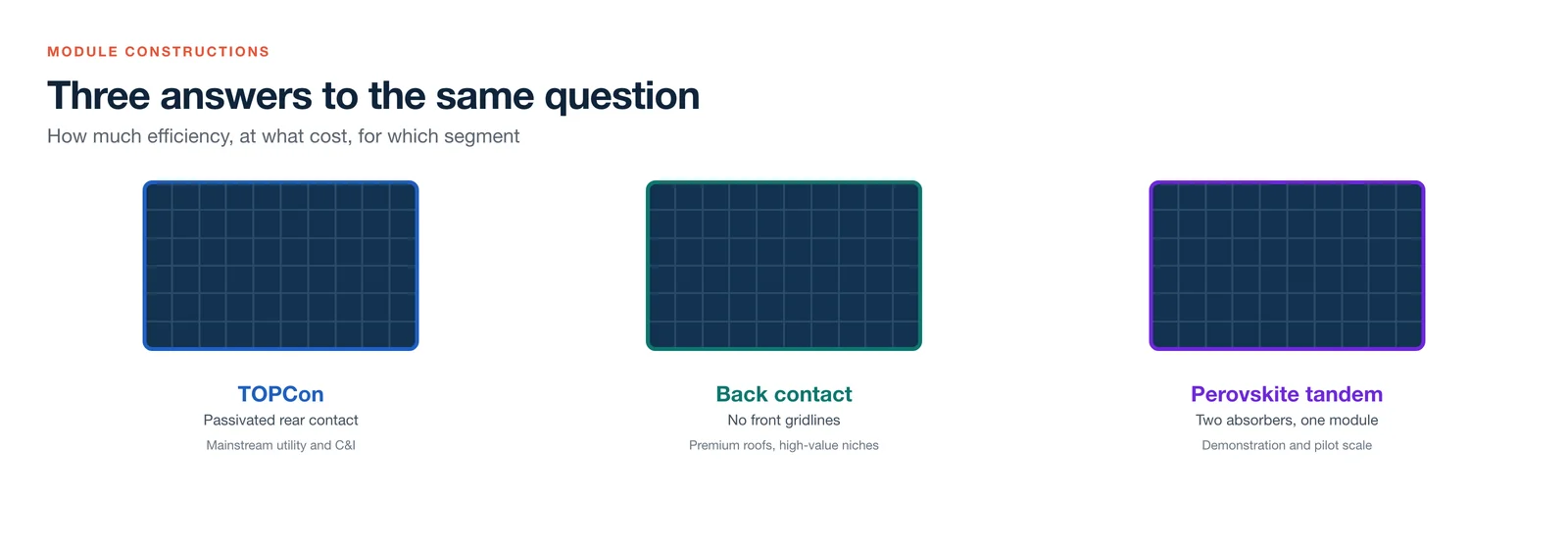
The industry tells itself two stories about this. The first is efficiency determinism: BC has a higher efficiency ceiling, therefore BC eventually replaces TOPCon. The second is ecosystem determinism: TOPCon's installed base is so large that it cannot be displaced.
Both contain truth and both are oversimplified. The real answer sits in the interaction between capacity scale, market structure, sunk cost and the ability to keep innovating — and it changes by segment.
The scorecard
| Metric | TOPCon | BC |
|---|---|---|
| Capacity | >800 GW, over 65% of global cell capacity | ~5–11% cell share, in ramp-up |
| Shipment share | 58% of global module shipments in H1 2026 | Concentrated in premium segments |
| Mass-production efficiency | Above 26% at cell level; modules up to 700 W | Module efficiency around 25% (TaiyangNews) |
| Investment | More than ¥500 billion over three years | Single-GW capex still above TOPCon |
| Positioning | First-choice mainstream route | Premium residential rooftops and differentiated niches |
| Ecosystem | Equipment, materials and talent fully built out | 30+ manufacturers, still expanding |
Read the table carefully and the conclusion is not "one wins". It is that these are different businesses at different stages.
TOPCon's moat is the ecosystem, not the efficiency
The ¥500 billion invested between 2024 and 2026 built more than factories. It built a supplier network: LPCVD and PECVD equipment vendors with installed bases and service engineers, paste and ribbon and encapsulant supply, trained process staff, and a bank of field data. Jinko, Trina, JA Solar and Tongwei all run TOPCon at scale, with cell efficiency above 26% and module power already at 700 W.
That matters because switching a technology route is not swapping a recipe. It means rebuilding lines, requalifying materials, retraining people and writing off equipment. Tens of thousands of companies sit inside the TOPCon ecosystem, and every one of them has a commercial interest in its continuity. This is the real moat: not a number on a datasheet, but the cost of coordinated change across an entire supply chain.
It also helps that TOPCon has not stood still. Successive generations — the industry is now talking about 3.0 — have improved both efficiency and cost. A technology that is still improving is harder to displace than a "legacy" one waiting to be retired.
BC's advantages are real, and so is its boundary
The case for BC is genuine. Its theoretical efficiency limit is around 29.1%, higher than the practical ceiling of mainstream TOPCon. With no front gridlines, it has more active area, looks better and suits premium architecture. Where land and balance-of-system costs are high, the extra watts per square metre translate into a lower levelised cost of electricity. Huatai Securities describes BC's advantage as an "efficiency premium".
But the premium segment has a size. Global high-end residential demand is estimated at roughly 30–40 GW a year. Utility-scale ground mount is 200 GW+. Even a dominant BC position in premium rooftops addresses a market several times smaller than TOPCon's home ground. To take half the market — as some BC advocates have promised — BC would have to break into utility-scale, which requires simultaneous breakthroughs in yield, cost and capacity. Today its capex per gigawatt is still higher than TOPCon's, its process is more complex and its ramp cycles are longer.
So "BC replaces TOPCon" is a narrative. "BC and TOPCon coexist by segment" is what the data supports.
How the leaders are responding: system-level innovation
The more interesting story in 2026 is not the rivalry itself but how each camp is defending its position.
Jinko's TAC platform
In October 2026 Jinko launched TAC, a tunnelling-passivation back-contact platform that fuses TOPCon's tunnel-oxide/poly-silicon contact with HJT's low-temperature amorphous-silicon passivation, and moves both contacts to the rear. Cell efficiency reaches 28%. The first product, Tiger Neo 5.0, is aimed at villas and premium residential roofs: 510 W in a 48-cell format, 25.52% module efficiency, 30 W more than a same-size conventional BC module, a temperature coefficient of −0.24%/°C and a warranty of up to 40 years.
The strategic message is as important as the product: the TOPCon leader is not defending a single architecture, it is absorbing the best ideas from both and building segment-specific products. Jinko also points out that its TOPCon base already supports more than 700 GW of installed capacity, and that AI-driven simulation is shortening its development cycles.
LONGi's technology forest
LONGi has gone the other way: deepen BC. At its July 2026 technology launch it presented eight innovations across efficiency, reliability and system intelligence. The ACM (nano-alloy matrix contact) process is already in mass production with gridline resistance half that of conventional TOPCon; an integrated conductive backsheet eliminates conventional ribbon and increases current-carrying cross-section by more than 85%. Shingled interconnection, hidden busbars, temperature-controlled alloy interconnection, smart modules and a module-level operating system were launched alongside.
By the end of 2025 LONGi held 510 granted BC patents, 330 of them invention patents, and BC module shipments worldwide are expected to approach 100 GW by the end of 2026, with more than 30 manufacturers now working on the route.
Both strategies share a logic: win by system-level innovation on your own route, rather than by chasing a single efficiency number.
Tandem: the shared next stop, still some distance away
Whatever the route, every leading manufacturer is working on the same next step — perovskite-silicon tandem — because the single-junction silicon ceiling of about 29.4% is now visible.
| Company | Tandem result | Certification |
|---|---|---|
| Jinko | 34.82% perovskite/TOPCon tandem, June 2026 (33rd record) | Third-party certified |
| LONGi | 35.5% silicon-perovskite tandem, July 2026 | ESTI (Europe) |
| Trina Solar | 907 W tandem module, 29.2% full-area efficiency | TÜV SÜD |
The bottlenecks are unchanged: long-term outdoor stability, because perovskite is sensitive to moisture, oxygen and UV and suffers ion migration and phase change; large-area yield and uniformity; and unproven mass-production process, encapsulation reliability and cost. The gap between a certified lab record and a production-line average will very likely be wider for tandem than for silicon, which has had a decade of learning.
One consensus is emerging, though: the bottom cell of a perovskite tandem is silicon, whichever route you pick. That means the ecosystem, lines and supply chain built during the silicon era migrate directly into the tandem era. TOPCon's ecosystem locks in the mainstream for the next decade; BC fights for the premium segment with a better structure; tandem is where everyone is headed — not as a replacement for silicon, but as its next efficiency step.
The bottom line
The TOPCon-versus-BC argument is about market share and technology leadership, not about which cell wins a laboratory comparison. TOPCon will remain the largest route for the foreseeable future on the strength of 800 GW of capacity, half a trillion yuan of investment and a complete ecosystem. BC will hold and grow a profitable premium segment alongside it. Tandem is the shared destination, gated by stability, yield and cost.
For buyers, the practical implication is simple: choose the architecture that fits the segment and the climate, then interrogate the manufacturer's process control and warranty terms. The route sets the ceiling; the factory decides whether you get near it.
Contact the ZOEAST PV engineering team for a segment-by-segment comparison, or browse the cell and module ranges.
Data sources: China Photovoltaic Industry Association H1 2026 shipment statistics; company announcements from Jinko, LONGi and Trina; TaiyangNews and Huatai Securities estimates. Figures are as publicly reported and may differ from audited results.
Figures: ZOEAST PV, redrawn in English from the original technical article.